
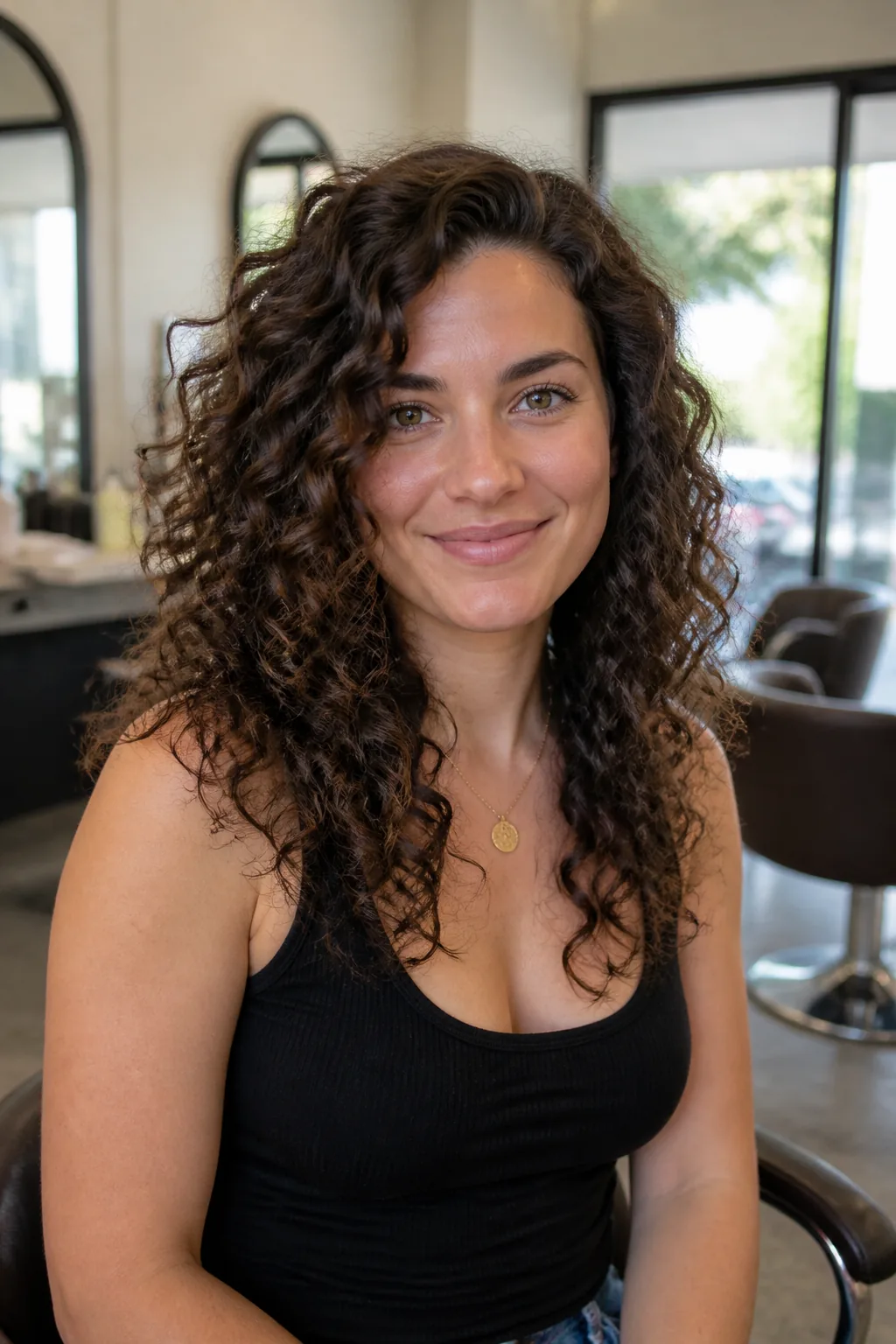
These 8 curly styles define your natural curls without the frizz by starting with the right cut, like a dry cut curl by curl, and a simple routine that respects your curl pattern instead of fighting it.
I spent most of my twenties trying to iron the curl out of my hair. Every morning meant a straightener, a round brush, and a silent deal with myself: if I just got it smooth enough, today would be a good hair day. It never was. By lunch the humidity had its way, my roots went fluffy, my ends went frizzy, and I looked like I’d been caught in the rain. Sound familiar?
The turning point came in a salon chair, when a stylist stopped me before she picked up her scissors and said, “Don’t straighten it before you come in. I want to see what your hair actually does.” She cut it dry, curl by curl, while I sat there fully expecting a disaster. It was the first time I left a salon with curls that looked like mine, only better. Not tamed. Not straightened. Just shaped.
Here’s the thing I wish someone had told me ten years earlier: curls don’t need fixing, they need the right cut and a routine that respects the curl pattern instead of fighting it. These curly hairstyles for women in 30s cover both. There are cuts that shape curls instead of chopping them, styling methods that give you definition without a shelf of products, and a simple routine that holds up past wash day. No heat tools required to create curls you don’t have, because these are for the curls you already do.
1. The Dry Cut, Curl by Curl
This is the single biggest change you can make, and it’s a cut, not a product. A dry cut means your stylist cuts your hair while it’s dry and worn in its natural curl pattern, snipping individual curls instead of combing everything straight and cutting across.
Why it matters: wet hair stretches, and curly hair shrinks as it dries. A cut that looks even when your hair is wet can spring up unevenly once it dries, which is how you end up with one side shorter than the other and a fringe that suddenly sits an inch higher than you asked for. Cutting dry removes the guesswork, because your stylist sees exactly where each curl will fall.
Who it suits: everyone with a visible curl pattern, but especially you if your curls are mixed, tighter at the nape and looser at the crown, or if you’ve ever left a salon happy and woken up the next morning to a completely different haircut.
Ask your stylist for: a dry cut on hair styled the way you normally wear it, cut curl by curl, with no thinning shears. Thinning shears chop through curl clumps and create frizz that shows up weeks later. Before you book, ask the salon one question: “Do you cut curly hair dry?” If the answer is no, keep looking.
Styling tip: wash and style your hair the way you normally do before the appointment, and don’t straighten it first. Your stylist needs to see your real curls, not your straightened version of them.
How often should you go back? Most curly cuts hold their shape for ten to twelve weeks, longer than a straight cut, because the shape grows out softer instead of sharper. If you cannot find a curly specialist near you, look for a stylist who at least cuts dry and is willing to cut a small section first so you can see the result before she continues. A careful stylist will welcome that request, and a rushed one will tell you everything you need to know by refusing it.
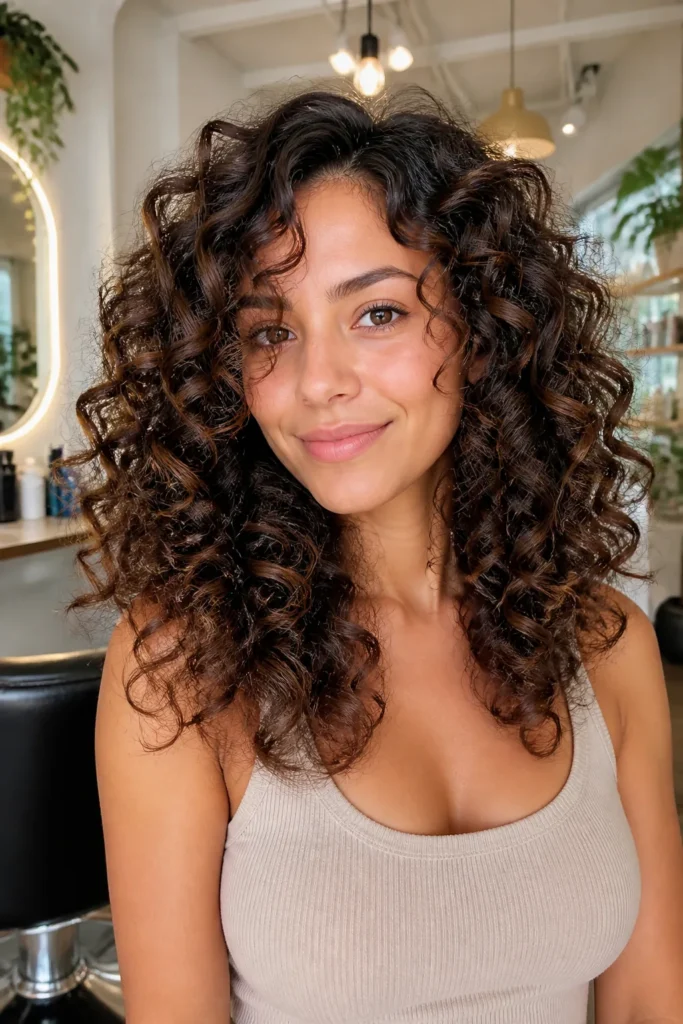
2. Long Curly Layers
Long layers on curly hair are a different animal from layers on straight hair, and the difference is how they’re cut. On curls, layers are carved into the curl pattern while the hair is dry, so each layer keeps its curl clump intact instead of being sliced across. The result is weight taken out from the inside, so your hair moves instead of sitting in one heavy block. These are among the most versatile curly hairstyles for women in 30s.
Who it suits: thick, dense curls that turn into a wide shelf at the bottom, and long curly hair that feels heavy and pulls flat at the roots. If your hair is fine and curly, keep the layers long and few, just two or three, so you don’t lose fullness at the ends.
Ask your stylist for: long layers cut dry, with the shortest layer still falling past your shoulders. Bring a photo of the back view, because that’s where a bad curly layering job shows up first, in a shelf line across the back that no amount of scrunching will hide.
Styling tip: this cut is the best friend of the wash-and-go routine below, because the layers give each curl room to form its own clump instead of gluing together into one mass.
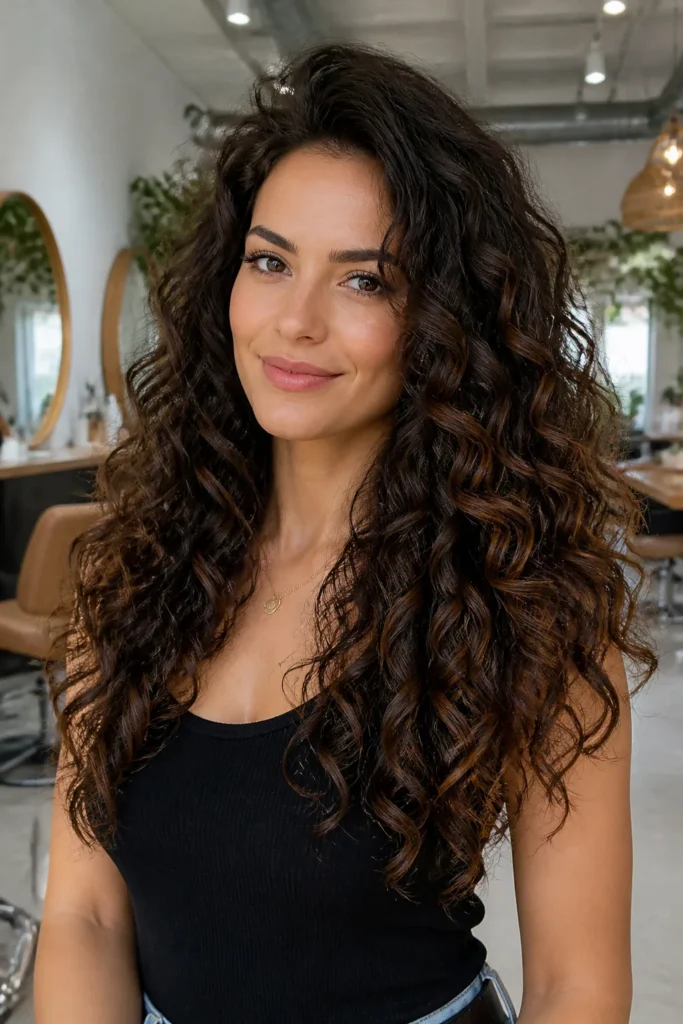
3. The Rounded Shape (Goodbye, Triangle)
If your hair is flat on top and wide at the bottom, you know the triangle problem, and no product fixes it, because it’s a shape problem, not a product problem. The rounded shape fixes it by building volume at the crown and taking weight out of the ends, so your silhouette goes from a pyramid to a soft round shape. It is one of the most flattering curly hairstyles for women in 30s for this shape problem.
Who it suits: medium and thick curls that widen as they grow out, and anyone whose hair looks great on wash day and like a triangle by day two. It’s also the shape to ask for if you’re growing your curls out and the in-between stage is driving you mad.
Ask your stylist for: a rounded outline with shorter layers at the crown to encourage lift, and the ends tapered rather than cut blunt across. On curls, a blunt hemline at the bottom adds width exactly where you don’t want it.
Styling tip: diffuse upside down for the first few minutes (see section 5) to set lift at the crown, because the cut gives you the shape and the drying method locks it in.
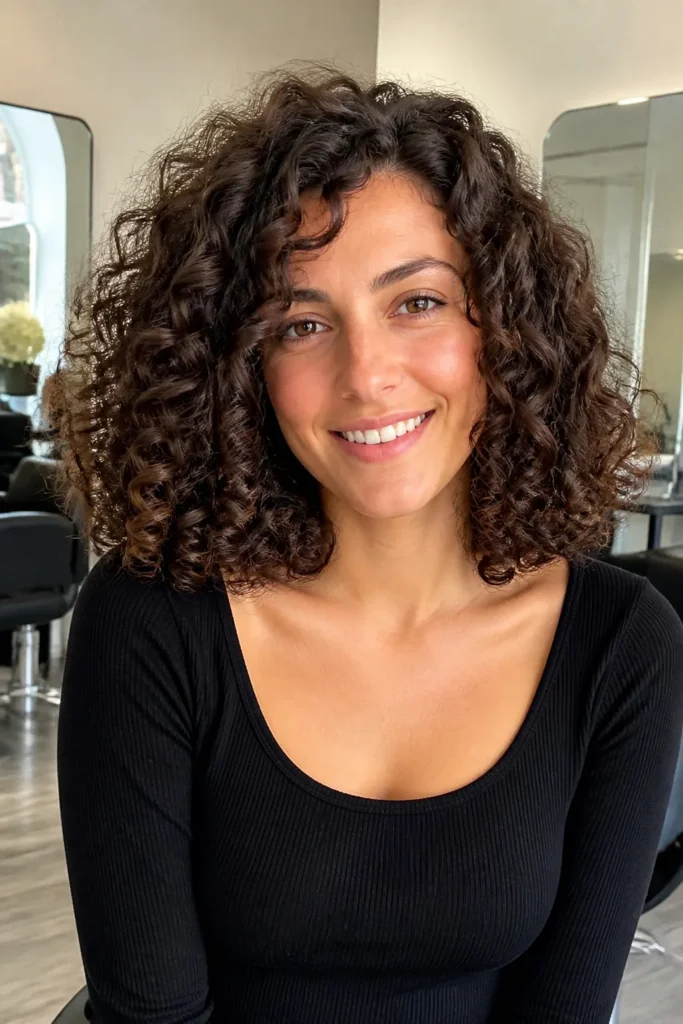
4. The Wash-and-Go, Done Properly
Wash-and-go sounds like doing nothing, but a good one is a short routine done in the right order, and the order is the whole trick. You apply products on soaking wet hair, in this sequence: leave-in conditioner first for moisture, then a curl cream for softness, then a gel for hold. Each layer does one job, and skipping the gel is why so many wash-and-gos fall apart by lunchtime. Done well, it is one of the simplest curly hairstyles for women in 30s.
Here’s the part nobody tells you: the gel will dry into a crunchy cast, and that’s supposed to happen. That cast is what holds your curl clumps in place while they dry. Once your hair is fully dry, you scrunch the crunch out gently with your hands (or a drop of oil on your palms), and the curls underneath are soft, defined, and still holding their shape. If you break the cast while your hair is still damp, you break the hold with it, and frizz moves straight in.
Who it suits: all curl types, with one adjustment. Fine curls need lighter products and less of them, or the hair goes stringy. Thick, dense curls can take richer creams and a stronger gel. Start with less product than you think you need and add more next wash day if your curls fall flat.
Styling tip: swap your regular towel for an old cotton T-shirt or a microfiber towel, and squeeze the water out instead of rubbing. Rubbing roughs up the curl surface, and a rough surface is a frizzy surface.
How much product should you actually use? Less than the bottle suggests, and more than you think, depending on your length. For shoulder-length curls, a coin-sized amount of leave-in, a similar amount of curl cream, and a golf-ball-sized amount of gel is a good starting point. For longer hair, double the cream and gel but keep the leave-in the same, because the roots do not need it. If your curls feel coated or stringy, you used too much cream. If they fall apart by lunch, you used too little gel. Adjust one product at a time, so you know which change made the difference.
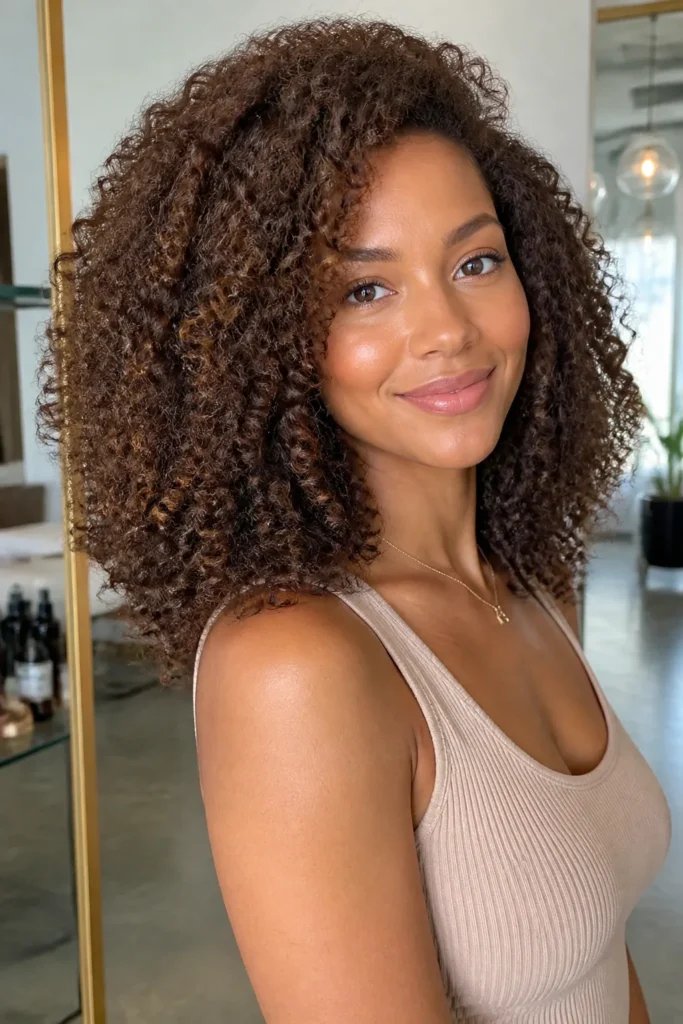
5. Diffusing Without the Frizz
If air-drying leaves you flat on top or frizzy by the afternoon, a diffuser is your answer, but only if you use it the right way. The two rules are low heat and low speed, and the third rule is the one most of us break: don’t touch your hair while it’s drying. It is a key method for curly hairstyles for women in 30s that need root volume.
How to do it: after your wash-and-go products are in, hover the diffuser around your roots first, without touching the hair, to set lift at the crown. Then cup sections of curls into the diffuser bowl and hold them there, still and patient, until each section is mostly dry. Move on to the next section. Don’t rake your fingers through, don’t flip your head around, don’t keep checking. Every touch while curls are damp breaks up the clumps you just formed.
Who it suits: anyone who needs volume at the roots, anyone whose air-dried curls go flat, and mornings when you can’t wait two hours for your hair to dry on its own. If your hair is very fine, diffuse for less time and let the rest air-dry, because over-drying fine curls makes them fluffy instead of defined.
Styling tip: stop at about 80 percent dry and let the last bit air-dry on its own. That last 20 percent is where over-drying (and the frizz that comes with it) usually happens.
Two ways to use the bowl, and both work. Hovering means holding the diffuser just away from your hair and letting warm air move around the roots, which gives lift without disturbing the clumps. Cupping means resting sections of curls into the bowl and holding them still, which gives more definition and a tighter finish. Start with hovering at the roots for volume, then cup the mid-lengths and ends for shape. If your diffuser did not come with a bowl attachment, a universal one costs little and fits most dryers, and it is worth buying before you blame your hair for what your tools are doing.
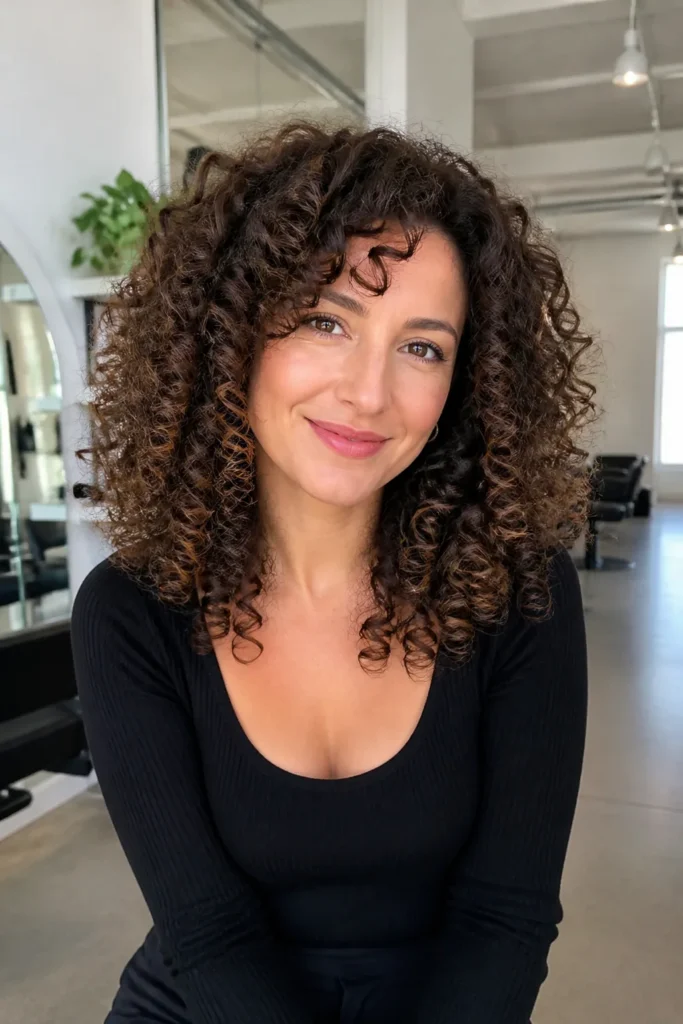
6. The Refresh Routine (Day 2 and Day 3 Curls)
Washing curly hair every day dries it out, but nobody wants to walk around with day-two frizz either. The refresh routine is the middle path, and it takes about five minutes. You don’t rewash. You wake the curls back up. It keeps curly hairstyles for women in 30s looking good between wash days.
How to do it: mist your hair lightly with water until it’s damp, not dripping. Smooth a small amount of leave-in conditioner or curl cream over the frizzy sections with your palms, then scrunch gently upward to encourage the clumps to reform. For pieces that have gone completely flat or straight overnight, wrap them around your finger for a few seconds to remind them of their shape. That’s it. No full routine, no rewash, no starting over.
Who it suits: everyone, but especially you if your curls look great on wash day and questionable by Tuesday. It’s also the routine that makes the wash-and-go worth doing properly in the first place, because a well-formed cast on day one refreshes far better than a half-hearted one.
Styling tip: sleep is half the refresh. A loose pineapple on top of your head (see section 8) or a silk scarf keeps your curls from getting crushed overnight, which means there’s less to fix in the morning.
Day two and day three are not the same refresh. On day two, a light mist and a little cream is usually enough, because the cast from wash day is still partly holding. On day three, the curls need more help, so add a little more water and work the cream through section by section instead of smoothing over the top. If day three still looks tired after a refresh, that is your hair telling you it wants a wash, not more product. Piling product onto three-day-old curls just coats them, and coated curls look dull no matter how much you scrunch.
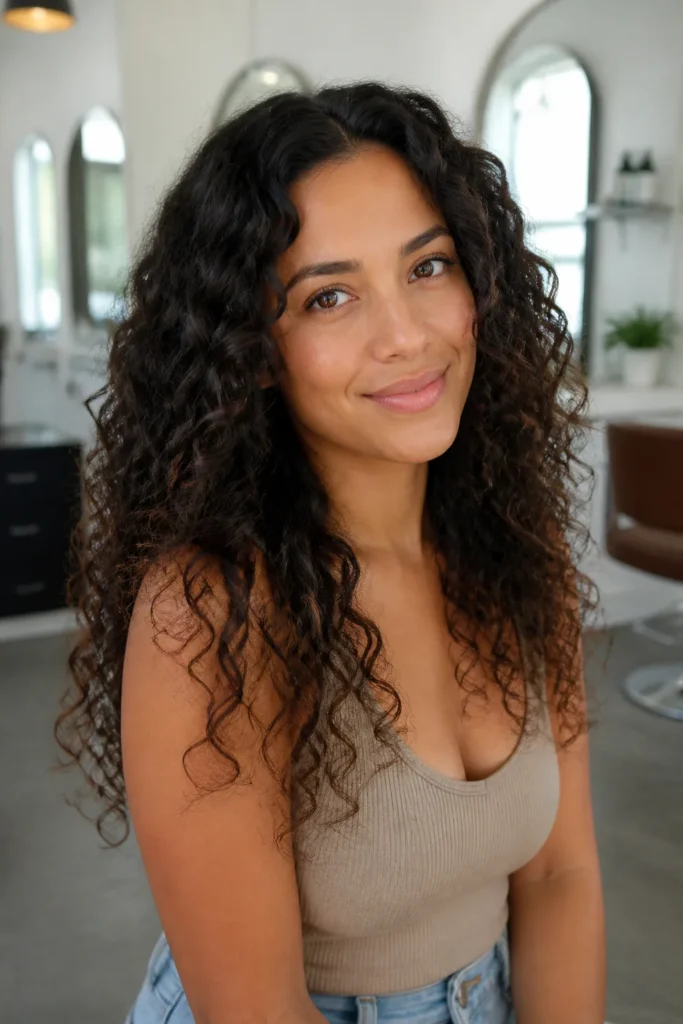
7. Twist-Out Definition for Looser Days
Some days your curls just won’t cooperate. The pattern is uneven, some pieces are defined and some are limp, and no amount of scrunching pulls it together. That’s when a twist-out earns its keep. You twist damp hair into two-strand twists, let them dry fully, then unravel them for a more uniform, defined curl pattern. It is one of the most reliable curly hairstyles for women in 30s for looser days.
How to do it: on damp hair with curl cream worked through, divide your hair into sections and twist each one from root to tip. The smaller the twists, the tighter the finished curl, so use bigger sections if you want a looser result. Then wait until the twists are completely dry before you unravel them. This is the part people rush, and rushing it is why twist-outs turn into frizz. Once they’re dry, unravel gently, separate the pieces with oiled fingers, and shake out the roots for volume.
Who it suits: looser curl patterns that lose definition easily, and anyone who wants a stretched, even look without heat. It’s also a lovely option for days when you want your curls to look intentional for an event but you don’t want to spend an hour styling.
Styling tip: twist-outs are not braids worn as a hairstyle, they’re a setting method for your own curl pattern. The finished look is your curls, just more even and defined than they woke up.
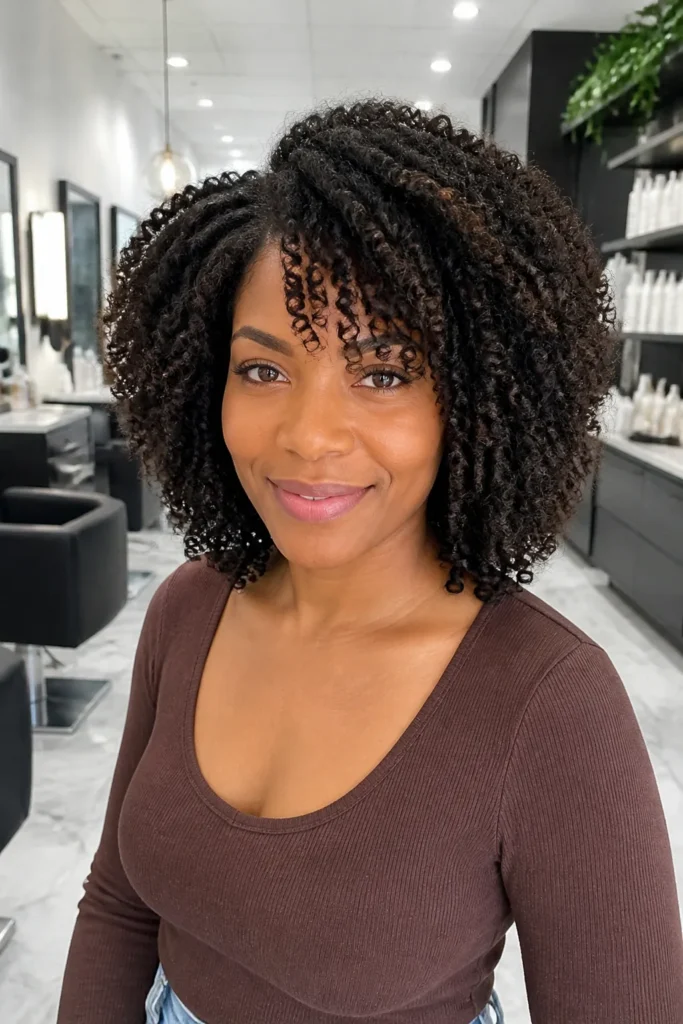
8. The Curly Puff and Pineapple Updos
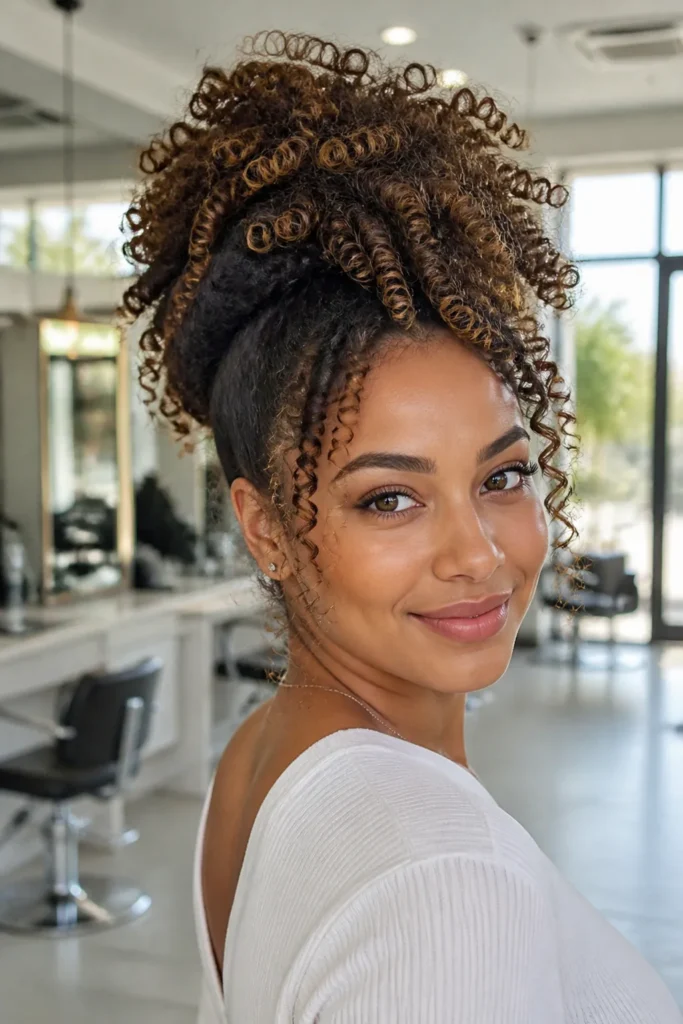
Some days you just need your hair up and out of the way, and curly hair has its own version of that: the puff and the pineapple. The puff is a loose, high gather that leaves your curl ends free and full, so you get height and shape instead of a scraped-back ponytail. The pineapple is the overnight version, a very loose high ponytail you sleep in so your curls don’t get crushed flat against the pillow. Both are easy curly hairstyles for women in 30s for busy days.
How to do it: for the puff, gather your hair up with your hands (not a brush, which breaks up the clumps) and secure it loosely with a silk scrunchie or a satin band, leaving the ends out to form a full shape on top. For the pineapple, do the same thing right before bed, but even looser, so there’s no tension on your roots overnight. In the morning, take it down, shake out the roots, and refresh only the pieces that need it.
Who it suits: second-day hair, gym mornings, work-from-home days, and anyone who wants an updo without straightening first. It’s also the kindest updo for curls, because there’s no pulling, no tight elastic, and no dent left behind.
Styling tip: never use a tight elastic on curls for an updo. Tight bands snap curls, leave dents that take a full wash to remove, and put tension on the hairline. Loose and soft is the whole point.
Which One Should You Pick?
Start with your curl type, then your mornings, and let those two answers choose for you.
Loose curls (soft waves to loose spirals): long curly layers, the wash-and-go, and the refresh routine will give you definition without weighing you down. Springy curls (classic ringlets): the dry cut, the rounded shape, and diffusing are your core three, because shape and drying method matter most for ringlets. Tight curls and coils: the dry cut, twist-outs for definition days, and the pineapple for overnight protection.
Now the lifestyle question. If you have ten minutes and a long to-do list, go with the dry cut, the refresh routine, and the curly puff. Those three carry you through a whole week. If you enjoy styling and you have twenty minutes, add diffusing and twist-outs to the rotation. And if you’re starting from scratch with curls you’ve been straightening for years, start with the dry cut alone. Everything else on this list works better on top of a good cut, and nothing on this list fixes a bad one.
Frequently Asked Questions
Should I brush my curly hair?
Only when it’s wet and full of conditioner, and only with a wide-tooth comb or your fingers. Never brush curly hair dry. A dry brush breaks up every curl clump you have and turns defined curls into one big fluffy cloud, and it snaps hairs along the way. If you need to detangle, do it in the shower while the conditioner is still in.
How often should I wash curly hair?
Two or three times a week suits most curly hair, and tighter, coarser curls can often go longer between washes. The refresh routine in section 6 exists precisely so you don’t have to wash daily. If your scalp feels itchy or coated, that’s a sign to wash, not a sign to add more product on top.
Why does my hair look great wet and frizzy dry?
Usually one of three things. You skipped the gel, so there’s nothing holding the clumps as they dry. You touched your hair while it was drying, which breaks clumps apart. Or you rubbed it with a regular towel, which roughs up the curl surface. Fix the sequence (leave-in, cream, gel), keep your hands off while it dries, and switch to a T-shirt or microfiber towel, and most of the wet-to-dry disappointment disappears.
Do I need a special stylist for curly hair?
Yes, and it’s worth finding one. You want a stylist who cuts curly hair dry and curl by curl, not one who combs it straight and cuts it wet. Ask before you book, and ask to see photos of their curly clients. A good curly cut costs the same as a regular cut, but it grows out better and needs fewer appointments to keep its shape.
Can I grow curly hair long without it turning into a triangle?
Yes. The combination is a dry cut, long curly layers, and a rounded shape, with trims every ten to twelve weeks so the layers don’t grow into a shelf. Long curly hair goes triangular when the ends carry all the weight and the crown stays flat, so the shape matters more than the length. Keep the crown lifted and the ends tapered, and length becomes your friend instead of your problem.
For the full picture, see our hairstyles and haircuts guide.
The Bottom Line
Curly hair in your 30s is not a problem to solve, it’s a pattern to work with. These curly hairstyles for women in 30s start with the cut: get it right first (dry, curl by curl, no thinning shears), keep the routine simple (leave-in, cream, gel, hands off while it dries), and let the refresh routine carry you between wash days. Most of the curl frustration I hear about comes from fighting the pattern with straightening tools and wet cuts, not from the curls themselves.
If you’re starting from one place only, start with the dry cut. It’s the foundation everything else on this list stands on, and it’s the change most women tell me they wish they’d made years earlier. Your curls already know what to do. Give them a shape that lets them do it.
If you want more hair help, the hair growth routine on this site pairs well with curly care, and the claw clip styles work beautifully on second-day curls when you want your hair up without a fight.