

A good evening routine for women in 30s is not a two hour spa ritual. It is a simple, repeatable wind down that starts about 90 minutes before bed: pick a fixed wake up time, close the kitchen, change out of your day clothes, do a five minute tidy, put your phone on charge outside the bedroom, dump tomorrow’s to do list on paper, and spend the last hour on something slow like reading, stretching, or a warm drink. Keep the same order every night, keep screens out of the last 30 minutes, and keep your wake up time steady even on weekends. That is the whole routine, and it works because your body starts to recognize the pattern and slow down on its own.
If you are lying awake at 1 a.m. replaying a work email, you are not alone. I spent years treating bedtime like a light switch, one minute answering messages, the next minute expecting sleep. It never worked. My brain needed a runway, and I was not giving it one.
Here is the thing: your 30s are busy in a very specific way. You might be juggling a job, a partner, kids, a home, and a group chat that never sleeps. By evening you are tired but wired, and that is the worst combination for sleep. You are exhausted enough to want bed and alert enough to stay up scrolling.
This evening routine for women in 30s is built for that reality. Nothing here needs special equipment, an early bedtime, or a quiet house. It needs about 90 minutes, a few small decisions made in advance, and the willingness to do the same things in the same order until they feel automatic. Start tonight, keep it simple, and let it build. For the full picture on building routines that stick, see our everyday routines guide.
1. Start With Your Wake Up Time, Not Your Bedtime

Most sleep advice starts with bedtime. That is backwards. Your wake up time is the anchor, because it sets your body clock for the next day. Pick a wake up time you can keep seven days a week, then count back seven to nine hours to find your bedtime window.
If you get up at 6:30 a.m. for work, your bedtime window is roughly 9:30 to 11:30 p.m. If you get up at 7:30, it is roughly 10:30 p.m. to 12:30 a.m. You do not have to hit the same minute every night. You do have to stop treating weekends like a different time zone, because sleeping in until 10 on Saturday makes Monday morning feel like jet lag.
Here is how to pick your anchor. Look at the earliest you must be up in a normal week, then add 30 minutes of buffer. That is your wake up time. Set one alarm for it, and put your phone across the room so you have to stand up to turn it off. I know, it sounds harsh. It also works, because the hardest part of the morning is the first 30 seconds.
Once the anchor is set, your evening routine has a start time. If bedtime is 10:30 p.m., the wind down starts at 9:00. If bedtime is 11:30, it starts at 10:00. Write both times on a sticky note and put it on the fridge for the first two weeks. You will not need it after that, the rhythm takes over.
2. The 90 Minute Wind Down Window

Think of the 90 minutes before bed as a dimmer switch, not a light switch. You are turning the day down gradually: less light, less noise, less input, less effort. Everything in this routine lives inside that window.
The first 30 minutes are the practical ones. Kitchen closed, clothes changed, quick tidy, tomorrow sorted. The middle 30 minutes are the slow ones. A shower or bath, skincare, something warm to drink. The last 30 minutes are the quiet ones. No screens, no news, no work talk. Reading, stretching, or just sitting still.
Why 90 minutes? Because your body needs time to cool down and your brain needs time to finish its open loops. You cannot go from a heated group chat to deep sleep in ten minutes. Anyone who tells you otherwise is selling something.
Your window will not be perfect every night. Some nights you get home late or work runs over. That is fine. A 30 minute wind down beats no wind down at all. Do the short version on busy nights (phone off, list written, lights low) and the full version when you can.
3. Close the Kitchen by 8 PM

Food and sleep are linked, and the link is simpler than most articles make it sound. A heavy meal right before bed makes sleep lighter, and a late coffee makes falling asleep harder. You do not need a diet plan. You need a kitchen closing time.
Aim to finish dinner at least two to three hours before bed. If your bedtime is 10:30 p.m., dinner is done by 8:00 or 8:30. After that, the kitchen is closed. No more cooking, no more snacking rounds, no standing at the fridge with the door open.
If you get hungry later, keep it small and boring: a banana, a few crackers, a small bowl of yogurt. The trick is to eat it sitting down, in the kitchen, not wandering around the house with a bag of chips. Boring is the point. You are telling your body the eating part of the day is over.
Caffeine has a longer tail than most of us admit. A coffee at 4 p.m. can still be in your system at bedtime, and the effect is not always feeling wired. Sometimes it just makes your sleep lighter without you knowing why. Try a cutoff of 2 p.m. for coffee and energy drinks, and switch to herbal tea or water after that. Give it a week and see if your 1 a.m. wake ups get rarer. If you love your afternoon coffee, keep the ritual and change the drink: decaf, a golden milk, or a good herbal tea in the same mug.
4. Change the Clothes, Change the Day

This is the smallest step in the routine and one of the most powerful. When you get home, change out of your work clothes and into something soft. Not a production, just a swap: the bra comes off, the jeans come off, something loose goes on.
It sounds too simple to matter, but your brain takes cues from what you wear. Work clothes mean work mode. Soft clothes mean the day is done. I swear by this one, because it creates a boundary your calendar cannot. Even if you work from home, change. Especially if you work from home, because your living room has been your office all day and your body needs the signal that the shift is over.
Pair the change with one more physical reset: wash your face, or take a warm shower. Warm water raises your body temperature slightly, and the cool down after it is one of the strongest natural sleep signals you have. You do not need a bath with candles and a playlist. A ten minute warm shower at 9 p.m. does the job.
If you shower in the morning instead, keep that and add a short version at night: warm water on your face and neck, clean pajamas, fresh socks if your feet run cold. Cold feet are a surprisingly common reason people cannot settle, and warm socks are a free fix.
5. The Five Minute Reset

A messy room makes a noisy mind, and you do not need a deep clean at 9 p.m. You need a five minute reset. Set a timer for five minutes and do only this: clear the kitchen counters, put the dishes in the sink or dishwasher, straighten the cushions, and clear one surface in your bedroom. That is it. When the timer goes off, stop.
The point is not a perfect house. The point is walking into your bedroom and seeing calm instead of chaos. If laundry is piled on the chair, move it. If the nightstand holds a charger, three books, and a glass from yesterday, clear it down to the lamp and one book.
Do the same for your bag and your keys. Put them in their home spot so the morning starts without a search. This tiny step pairs perfectly with an easier morning, and if you want the full morning version, it is here.
One more piece of the reset: lay out tomorrow’s clothes. Not a full outfit plan, just the next day’s clothes on a chair or a hook. It takes 60 seconds at night and saves a ten minute stare into the closet at 6:30 a.m. If you have kids, lay theirs out too, or at least the shoes and the bag by the door. Future you is already grateful.
6. Put the Phone to Bed Before You
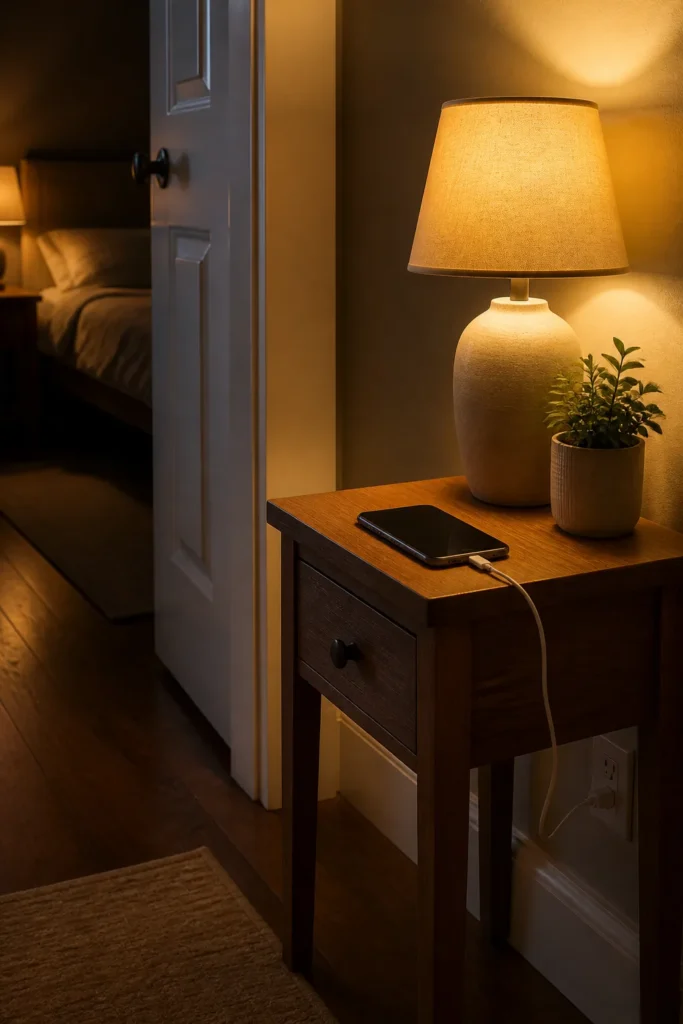
This is the step everyone resists and the step that changes the most. Your phone is the single biggest reason your evening routine falls apart, because it is a work inbox, a news feed, a shopping mall, and a slot machine in one small box. You cannot wind down while holding it.
Here is the rule: the phone goes on charge outside the bedroom, 30 minutes before bed. Not on silent next to you. Not face down on the nightstand. Outside the room, on charge, in the kitchen or the hallway.
If you use your phone as an alarm, buy a ten dollar alarm clock. It is the best sleep purchase you will ever make, and it pays for itself the first week. If you need the phone nearby for a genuine reason, like a sick child or an on-call shift, put it on Do Not Disturb with only one or two contacts allowed through, and put it face down across the room.
The first three nights will feel strange. Your hand will reach for the phone out of habit, and you will feel a small jolt of boredom. That boredom is the point. Boredom is the doorway to sleep, and your brain has forgotten how to be bored because the phone filled every gap. Sit with it. Read a page, stretch, stare at the ceiling. The jolt passes in a few days, and what replaces it is the best part: you fall asleep faster.
7. Dump It on Paper

Your brain keeps you awake by replaying the things you have not finished. The fix is embarrassingly simple: write them down before bed. A brain dump takes five minutes and it works because your brain trusts paper more than it trusts your memory at midnight.
Keep a small notebook and a pen by your bed, or on the kitchen counter if the phone is already banished. At about 30 minutes before bed, write down three things: tomorrow’s top three tasks, anything you are worried about, and anything you need to remember. Do not organize it. Do not make it pretty. Just get it out of your head and onto the page.
Tomorrow’s top three is the most important part. Not ten things, three. The three that would make tomorrow feel like a win if you did them. Everything else can wait, and saying so on paper is what lets your brain stop rehearsing the list.
If a worry pops up while you are writing, give it one line and one next step. “Email the plumber” beats “the bathroom is falling apart.” Your brain is not asking you to solve it at 10 p.m. It is asking you to prove you will not forget it. The note is the proof.
On Sunday nights, do a slightly longer version. Spend ten minutes planning the week: the three big things, the appointments, the meals if you plan them. That Sunday reset is the difference between a calm Monday and a chaotic one, and the full version lives here.
8. The Slow Hour

Once the practical steps are done, the last hour is for slowing down. This is the part of the evening routine that actually feels good, and it is the part you will protect once you have felt it work. Pick one slow activity and do it every night, same time, same place.
Reading is the classic for a reason. A physical book, a few pages, in a chair that is not your bed. Fiction works better than self improvement, because you want your mind to wander into a story, not into a project. Keep the book on your nightstand so you never have to decide what to read. The decision is the enemy, the habit is the friend.
Stretching is the other strong option, and it suits women in 30s who sit all day. Ten minutes, on the floor, nothing fancy: neck rolls, a forward fold, a gentle twist, legs up the wall for the last two minutes. You are not working out. You are telling your muscles the day is done. If you want a routine that is already written out, the winter wellness post has a simple one that works year round.
What does not count as slow: scrolling, shopping, email, news, or a show that leaves you buzzing. If the activity leaves your heart rate up or your mind racing, it is not the slow hour. Save it for tomorrow. Your 30s are full enough without borrowing excitement from bedtime.
9. The Last 20 Minutes

The last 20 minutes are the smallest, quietest part of the routine, and they are worth protecting like a ritual. This is skincare, teeth, lights low, and into bed. No new information enters the system after this point.
Keep your night skincare simple, because a ten step routine at 10:30 p.m. is a chore, not a ritual. Cleanse, moisturize, and anything else you genuinely use, in the same order every night. If your skin is simple, your routine can be simple: a gentle cleanser and a good moisturizer is a complete routine. The point is the repetition, not the product count. The warm water and the slow pace are doing as much as the cream.
Brush your teeth, dim the lights in the bedroom, and get into bed. If you read in bed, set a page limit or a time limit, ten minutes, then lights out. Reading in bed is fine. Reading in bed for an hour while telling yourself you will stop soon is not.
Temperature matters more than most people think. A cool room, roughly 65 to 68 degrees Fahrenheit, helps most people sleep better, and a light blanket you can kick off beats a heavy one you are trapped under. If you run hot, a fan and a thin sheet will do more for your sleep than any supplement. If you run cold, warm socks and a hot water bottle at your feet.
One more small thing: keep the bedroom dark. A sleep mask costs very little and fixes streetlights, a partner’s late reading lamp, and early summer sun in one move. If your curtains let in a strip of light, the mask is the fastest fix.
10. When Sleep Does Not Come

Even with a perfect evening routine, some nights sleep will not come. That is normal, and how you handle those nights matters as much as the routine itself. The worst thing you can do is lie there doing math on how many hours are left. The math always makes it worse.
If you have been awake for about 20 minutes and you are getting frustrated, get up. Go to another room, keep the lights low, and do something boring: read a dull page, fold laundry, sit with a glass of water. When your eyes feel heavy, go back to bed. You are teaching your brain that the bed is for sleep, not for worrying.
Do not pick up your phone. Do not check the time every five minutes. Do not start a show “just to fall asleep to.” Every one of those resets the clock and makes the next hour harder. Boredom is your friend on these nights too, and it is the fastest way back to sleep.
A bad night does not ruin the routine. One rough night after three good ones is a blip, not a failure. Get up at your normal time anyway, get some daylight in the first hour, and keep the routine that night. Your body clock is built on the pattern across the week, not on any single night. If broken sleep lasts for weeks and starts to affect your days, that is a different conversation, and it is worth talking to your doctor about it rather than collecting more tips.
Make It Fit Your Life
A routine only works if it fits your actual life, so here are three versions of this evening routine for women in 30s, built from the same steps, timed differently.
The 9 to 5 day. Home at 6:30, dinner done by 7:30, kitchen closed at 8:00. Clothes changed at 6:45, five minute reset at 8:15, phone on charge at 9:30, brain dump at 9:45, slow hour 9:30 to 10:30, lights out at 10:30. Wake up at 6:30. This is the standard version, and it fits most office days.
The work from home day. The danger here is that work never ends, because the laptop is always in the next room. Close the laptop at 6:00 and put it in a drawer or a bag, out of sight. Change clothes at 6:05, even though you never left the house, because the change is the boundary. Everything else runs the same, and the phone still leaves the bedroom at 10:00. If your work from home days bleed into your evenings, the longer version of the boundary problem is worth a read, and it pairs well with a calmer morning.
The early morning mum. If you are up at 5:30 with small kids, your bedtime needs to be 9:30, and your wind down starts at 8:00. That means dinner is early, the kitchen closes at 7:30, and the slow hour is really a slow 30 minutes. Do the five minute reset while the kids brush their teeth, do the brain dump on the kitchen counter, and skip the bath. A short routine done every night beats a long routine done twice. On the weeks when everything feels like too much, the busy week self care post has the gentlest version of all of this.
Pick the version closest to your life, adjust the times to your wake up anchor, and run it for two weeks before you change anything. Two weeks is enough for the pattern to form, and short enough that you will actually do it.
Frequently Asked Questions
How long should an evening routine be?
About 90 minutes from the first wind down step to lights out, but the number is a guide, not a rule. A 30 minute version on a busy night still counts: phone off, list written, lights low, into bed. What matters is the same order and the same wake up time, repeated night after night. Start with 30 minutes if 90 feels impossible, and add time once the habit sticks.
What time should I start my evening routine?
Count back 90 minutes from your bedtime, and count your bedtime back from your wake up time. If you get up at 6:30 a.m., bedtime is around 10:30 p.m. and the routine starts around 9:00. If you get up at 7:30, bedtime is around 11:30 and the routine starts around 10:00. Write both times down for the first two weeks until they feel automatic.
Is it okay to watch TV as part of an evening routine?
Yes, with two limits. Keep it earlier in the evening, not in the last 30 minutes, and keep it light. A familiar show you have seen before is a good wind down. A tense drama, the news, or a show you are bingeing until 1 a.m. is not. If you notice you sleep worse on TV nights, move the show earlier or swap it for reading for a week and compare.
What if my partner stays up later than me?
This is common, and it is fixable without a fight. Agree on the shared steps, like the kitchen closing and the five minute reset, and let the quiet steps be yours alone. Your partner can keep the living room lamp on while you read in bed, and a sleep mask plus earplugs handles the rest. The phone rule is the one worth holding firm on, because a lit screen next to you affects your sleep even if it is not your screen.
How long does it take for an evening routine to help me sleep better?
Most people notice the first change within a week: falling asleep faster, because the wind down replaces the scrolling. The deeper change, waking up less in the night and feeling rested in the morning, usually takes two to three weeks of steady wake up times. If nothing changes after three consistent weeks, look at the two biggest levers first: the phone leaving the bedroom, and a fixed wake up time seven days a week.
The Bottom Line
A calm evening routine for women in 30s is not about doing more. It is about doing less, in the same order, at the same time, every night. Pick your wake up time, wind down for 90 minutes, close the kitchen, change your clothes, tidy for five minutes, put the phone outside the bedroom, dump tomorrow on paper, and spend the last hour on something slow. Then get into bed and let your body do the rest.
You do not need a perfect night to start. You need one ordinary night, done in order, and then another one tomorrow. The routine builds itself from there, and the sleep follows. Start tonight, keep it simple, and give it two weeks before you judge it.