
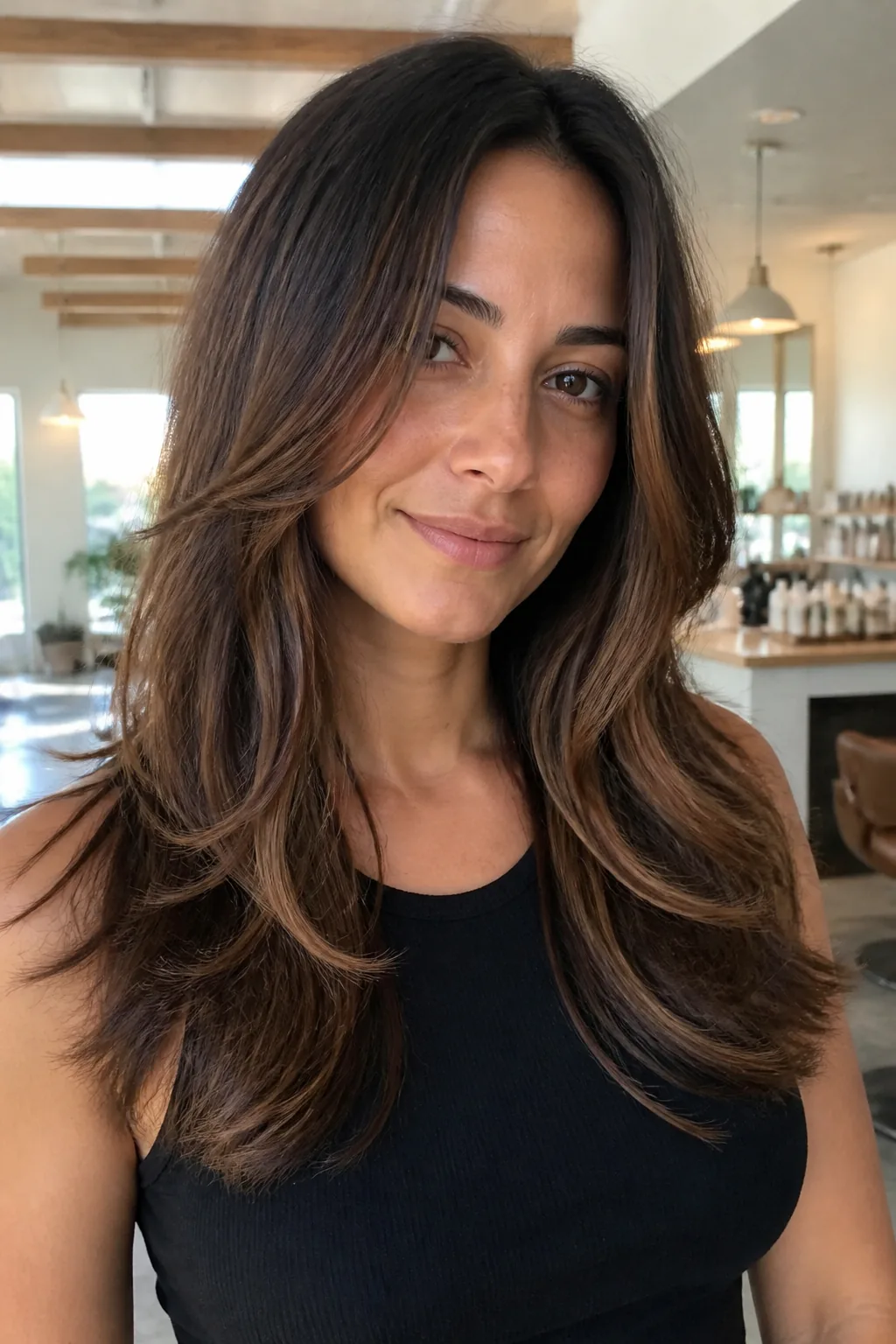
The secret to layered haircuts for fine hair is short, strategic layers that create movement without removing weight: keep the perimeter strong, add layers where they build lift, and the hair looks thicker, not thinner. Cut the layers in the wrong place and fine hair collapses, so placement matters more than quantity.
Fine hair and layers have a complicated history, and most of it comes from one mistake: too many layers, cut too short, all over the head. That version of layering removes exactly the weight fine hair needs, and the result is hair that looks thinner than it did before the cut. It is no wonder so many women with fine hair are afraid of layers.
But layers done right are the single best tool for fine hair, because they create the movement and lift that fine hair cannot produce on its own. The layered haircuts for fine hair below are all cut-focused: they describe the cut to ask for, where the layers sit, and what each version does for fine hair specifically. They are about the scissors, not the styling, though each section notes how to wear the cut day to day.
One honest note before we start: bring photographs to your appointment, and be specific about where you want the layers. “Some layers” is not a clear instruction, and it is how fine hair ends up over-layered. The descriptions below give you the language to ask for exactly what you want. It also helps to tell your stylist three things before the scissors come out: how you usually wear your hair day to day, whether you air dry or blow dry most mornings, and how long you want to go between trims. Those three answers change which version suits you more than any photograph can, because a cut that needs a daily blow dry is the wrong cut for someone who air dries. A good stylist will adjust the layers to your routine, not just to the picture, so say the routine out loud before the consultation ends.
1. Long Layers With Face Framing
This is the safest layered cut for fine hair, and the one to start with if you have never had layers. The layers stay long, mostly below the chin, with the shortest pieces framing the face from the cheekbone down. The perimeter, the bottom edge of the hair, stays strong and blunt, which preserves the appearance of thickness.
The face-framing pieces are doing the real work here. They create movement around the face and the illusion of layers throughout, while the back of the hair keeps its weight. Ask your stylist to keep the layers long and connected, meaning each layer blends into the next, rather than short and choppy, which would remove too much bulk.
This cut suits nearly every face shape, and it is the safest of all layered haircuts for fine hair, because the face framing can be adjusted: longer pieces for a round face, shorter pieces for a long face. It also grows out gracefully, which matters for fine hair, since grow-out is when a bad layering job shows most. Wear it with soft waves for maximum fullness, or straight for a sleek, polished look.
2. The Shoulder-Length Layered Lob
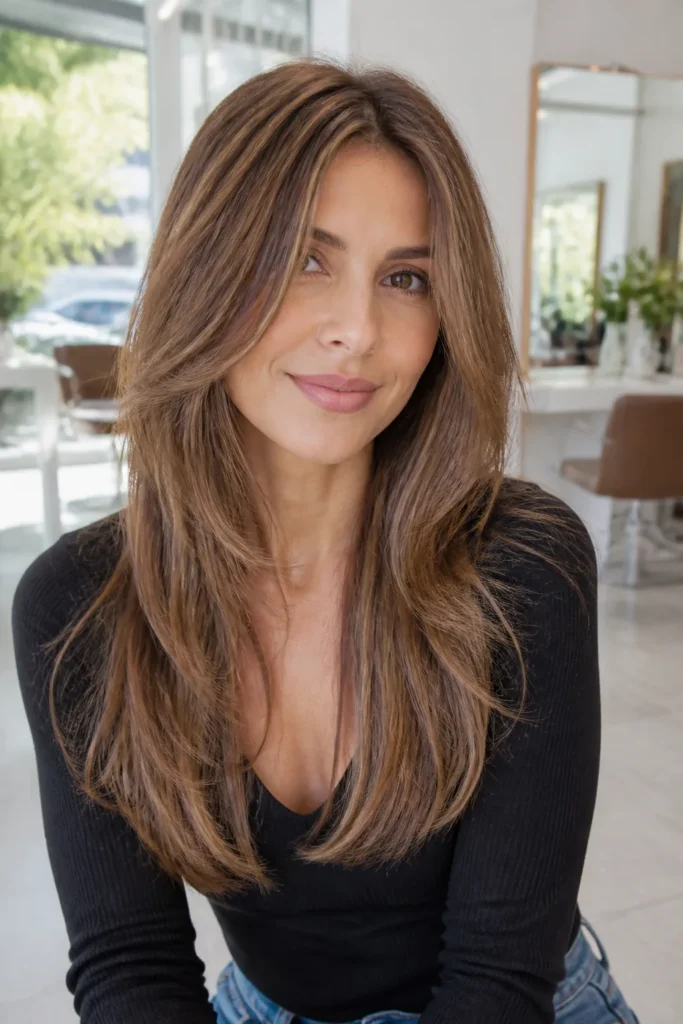
The lob, a long bob that sits around the shoulders, is one of the best cuts for fine hair, because the shorter length instantly makes the hair look thicker. Add long layers through the ends and a few shorter pieces around the face, and the lob gains movement without losing its blunt, full edge.
The length is the key decision here. At the shoulders, the hair is short enough to look full but long enough to tie back, which is the practical balance most women want. Ask for the layers to start no higher than the chin, and for the perimeter to stay blunt. Layers that start too high on fine hair create a thin, wispy top section that is hard to style.
This cut is the best choice if your fine hair is also long and straggly at the ends, because cutting to the shoulders removes the thinnest part of the hair in one move. It is also the easiest layered cut to style: a quick blow dry with a round brush gives it shape, and it holds a wave well through the day. Brush size matters for the lob: a medium round brush, roughly two inches across, gives the right balance of smoothness and volume, while a large brush flattens the layers and a small one creates too much curl. Work in sections, drying the underneath layers first and the top section last, so the top falls over a smooth base. A cool shot at the end of each section locks in the shape, which is what keeps the lob looking polished at evening after a morning blow dry.
3. The Layered Bob for Fine Hair
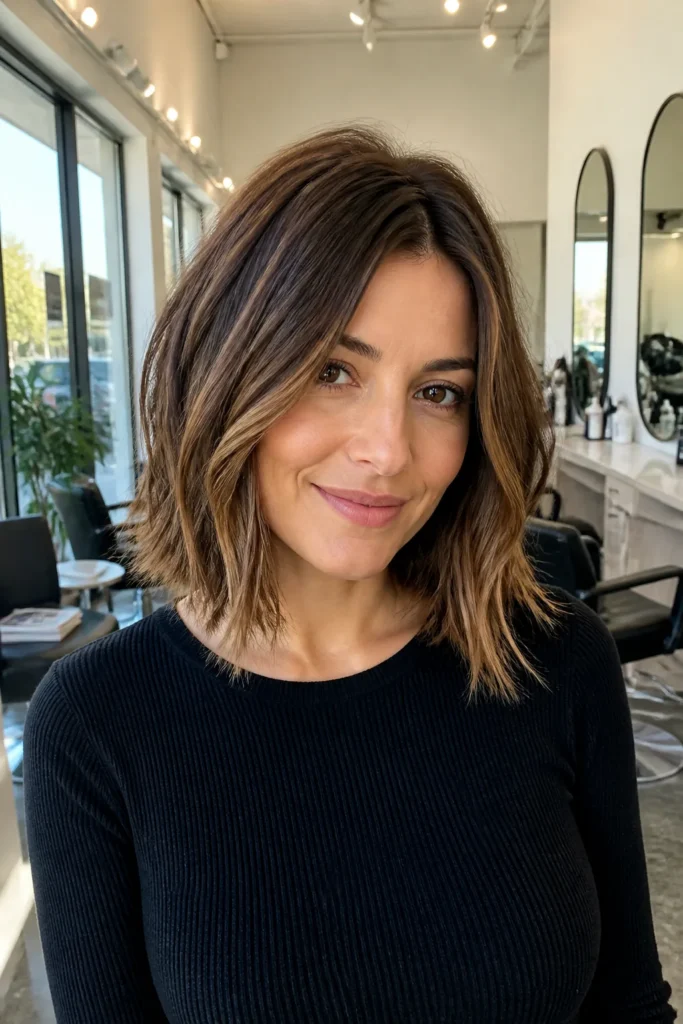
A bob is a bold choice for fine hair, and it pays off, because a shorter cut concentrates the hair you have into a smaller area, which reads as thickness. The layered version adds movement through the ends and a few soft pieces around the face, while keeping the classic bob shape: shorter at the back, slightly longer at the front.
The layers here should be subtle, not dramatic. Ask for light layering through the ends only, with the bulk of the shape coming from the bob’s structure rather than from internal layers. Heavy internal layering on a bob removes the weight that makes the bob look full, and the result is a shape that collapses by midday.
This version of layered haircuts for fine hair is the best choice if you want a real change, not just a trim with layers. It suits oval, heart-shaped, and square faces well, and it is especially flattering with a side part, which adds asymmetry and volume at the crown. It needs a trim every six to eight weeks to keep its shape, which is worth knowing before you commit.
4. Feathered Layers
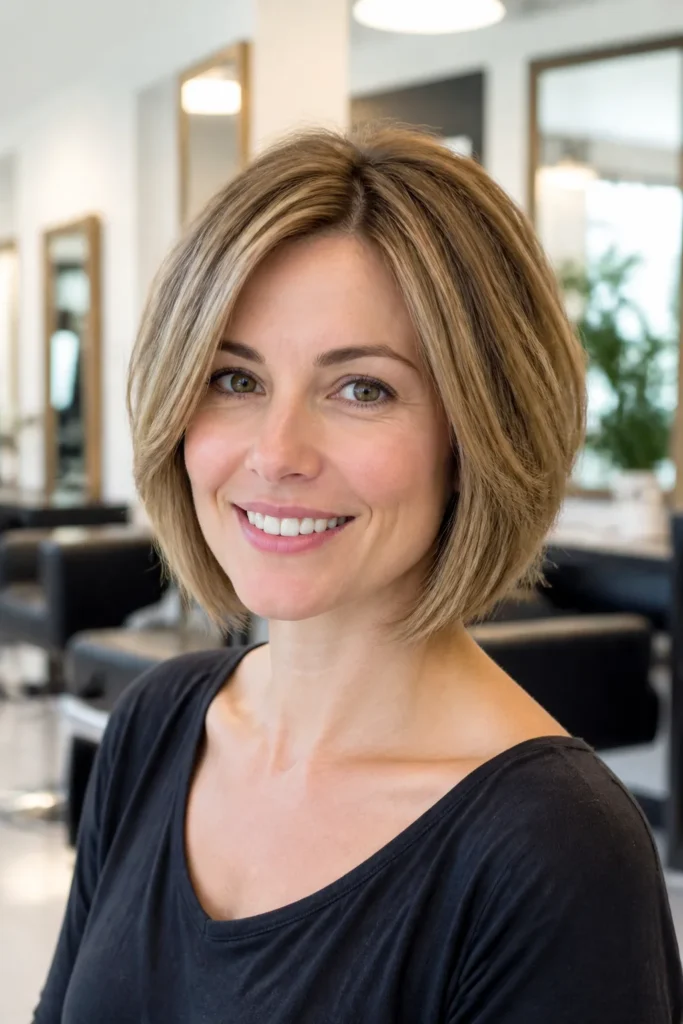
Feathered layers are the softest version of layering, and they suit fine hair well because they remove very little weight. The layers are cut at an angle so the ends taper and flick outward slightly, creating a feathered edge that moves when you do. The overall length stays long, and the feathering is concentrated through the ends and around the face.
The key instruction for your stylist is that the feathering should be light and blended, not choppy. Styling feathered layers is a choice between two tools: a paddle brush gives a smooth, sleek finish that shows the feathering subtly, while a round brush builds volume and makes the feathered ends flick outward more visibly. For everyday wear, the paddle brush is faster and gentler on fine hair, since it does not pull at the ends the way a round brush can. For occasions, the round brush earns its extra time by making the feathering a visible feature rather than a hidden one. Heavy feathering on fine hair creates thin, wispy ends that look sparse, while light feathering creates movement while keeping the ends looking full. Ask for the feathering to start no higher than the jaw, so the top section keeps its density.
This cut is the best choice if you want movement without a visible change in length or shape. It is subtle, which is its strength: people will notice your hair looks better without being able to say why. Wear it with a blow dry that flicks the ends outward slightly, and the feathering does the rest.
5. Layers With Curtain Bangs
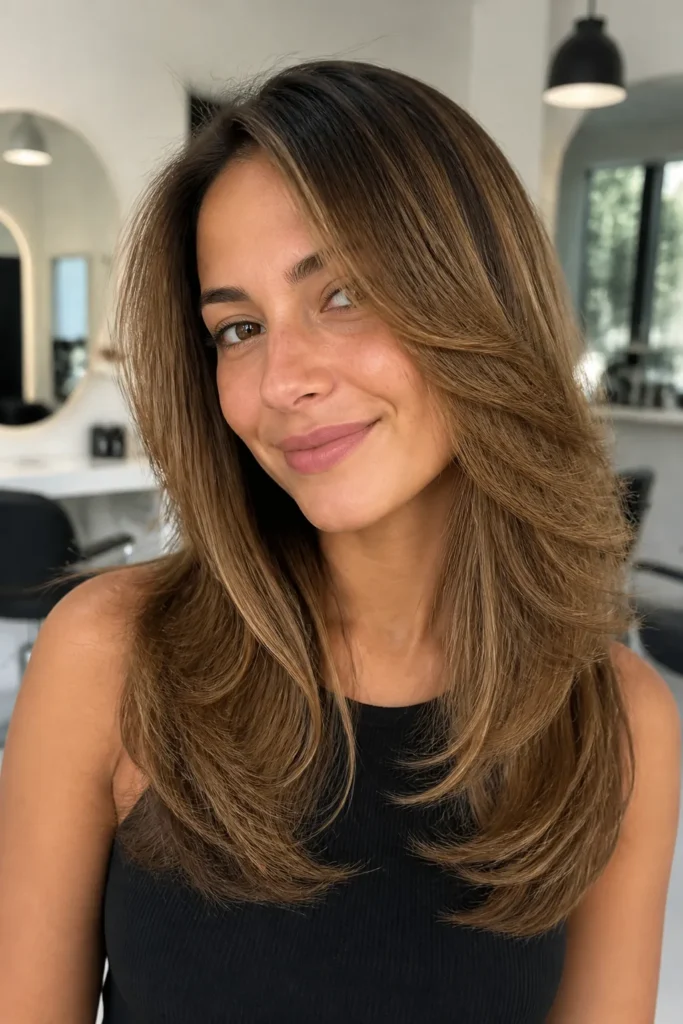
Curtain bangs paired with long layers are one of the most flattering combinations for fine hair, because the bangs create fullness around the face while the layers create movement through the lengths. The bangs part in the middle and sweep to each side, ending around the cheekbone, and the layers stay long and connected below.
The bangs are doing structural work here, not just decorative work. They add volume where fine hair tends to fall flat, right around the face, and they draw the eye to the fullest part of the style. Ask for the bangs to be cut long and feathered, so they blend into the layers rather than sitting as a separate block.
This version of layered haircuts for fine hair is the best choice if your fine hair also lacks shape around the face. It suits nearly every face shape, and it grows out gracefully, since the bangs simply lengthen into face-framing layers. Style the bangs with a round brush, sweeping each side away from the face, and the whole cut falls into place.
6. Choppy Ends for Movement
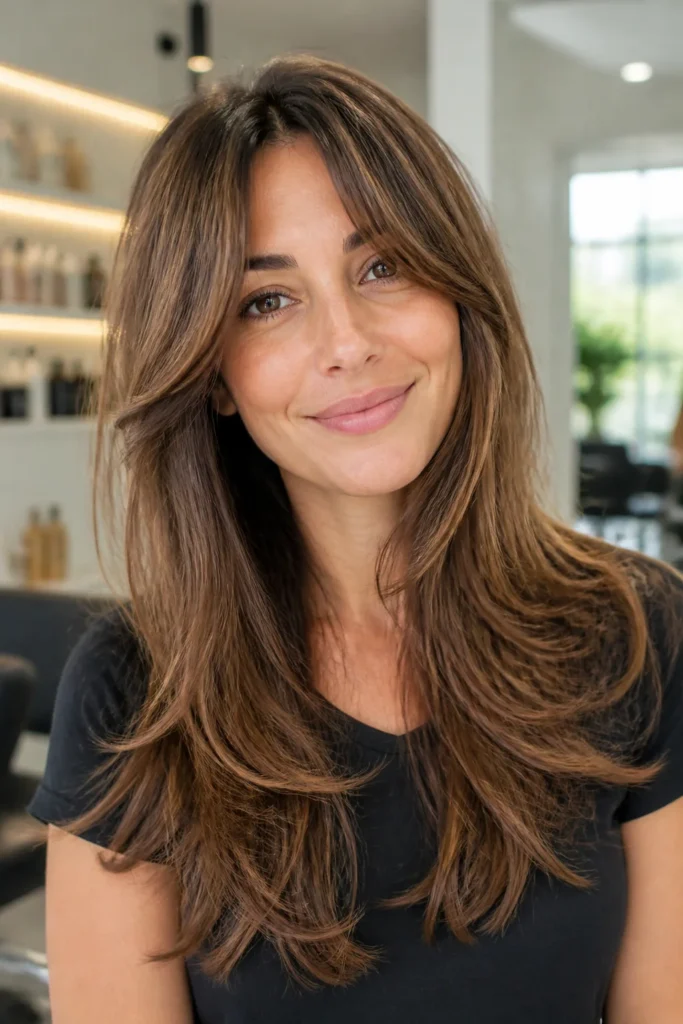
Choppy ends sound risky for fine hair, and they are, if they are cut too short or too aggressively. Done lightly, though, a choppy texture through the very ends creates movement and a modern edge without removing meaningful weight. The chop is confined to the last inch or two of the hair, while the rest of the cut stays solid.
The critical instruction is that the choppiness stays at the ends only. Growing out choppy ends needs a plan, since the texture grows out into unevenness faster than a blunt edge does. Book a trim every eight weeks while growing the cut out, and ask the stylist to gradually soften the chop rather than cutting it all off at once, which would remove length you may want to keep. Between trims, a light smoothing cream on the very ends keeps the texture looking intentional rather than ragged, which is the difference between a grown-out style and a neglected one. Internal choppy layering throughout the hair is what thins fine hair out, while end-only texture just breaks up a blunt edge so it moves more naturally. Ask your stylist to point-cut the ends lightly, which creates texture without obvious steps.
This cut is the best choice if your fine hair feels heavy and lifeless at the ends despite being thin overall, which happens when a blunt cut sits too solidly. The choppy ends give the hair permission to move, and the movement reads as fullness. It needs a trim every eight weeks to keep the texture fresh, since choppy ends grow out into unevenness faster than a blunt edge.
7. The Layered Cut With a Side Part
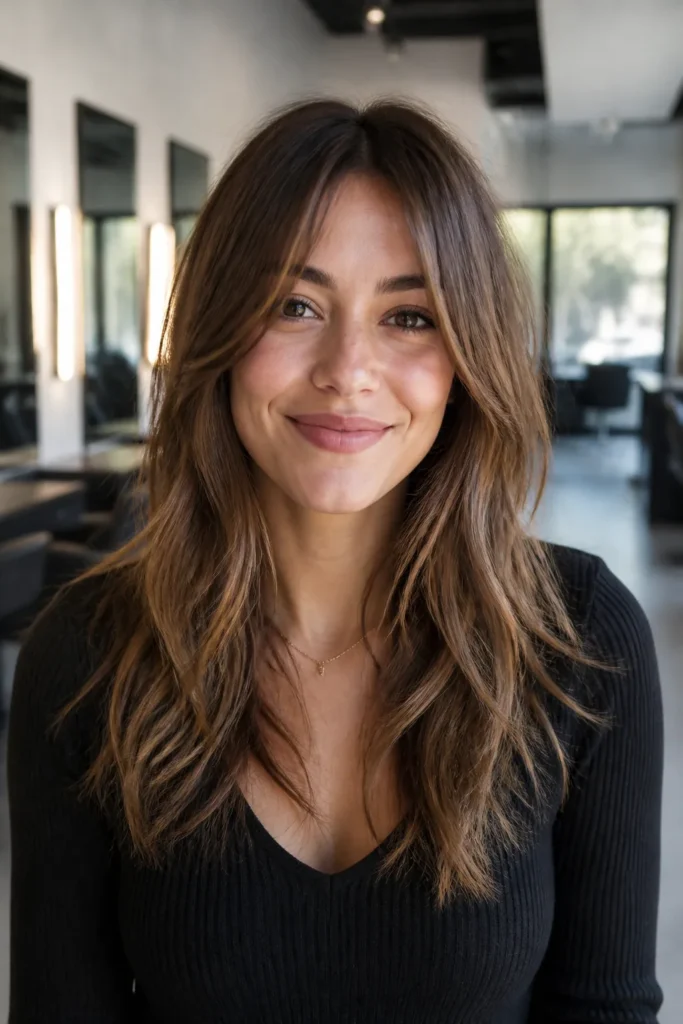
A side part changes how layers fall, and for fine hair that change is almost always for the better. The deep side part piles more hair onto one side, which creates the illusion of thickness, while the layers underneath create lift at the crown. The cut itself is long layers with face framing, but the part transforms how it reads.
Ask for the layers to be cut with the side part in mind, meaning the shorter face-framing pieces sit on the heavier side of the part, where they have the most hair to work with. Layers cut for a center part and then worn with a side part often fall unevenly, so tell your stylist how you actually wear your hair before the scissors come out.
This version of layered haircuts for fine hair is the best choice if you already part on the side, or if your fine hair falls flat with a center part. The asymmetry adds volume that no product can fake, and the layers keep the heavier side from looking like a solid curtain. It is a small change in parting with a large change in how full the hair looks.
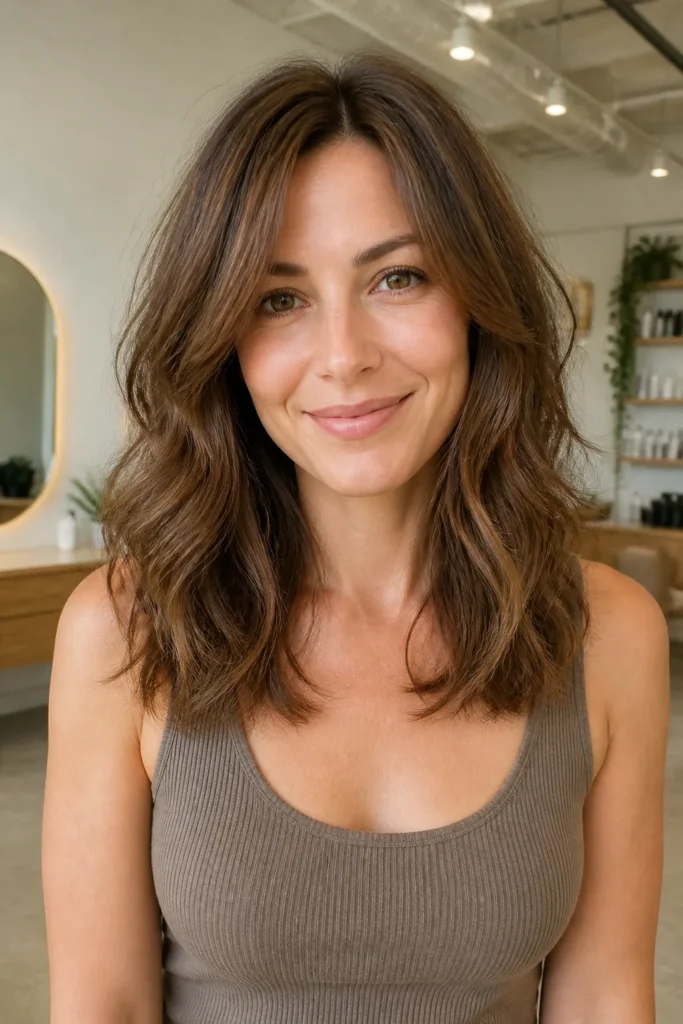
8. Layers for Wavy Fine Hair
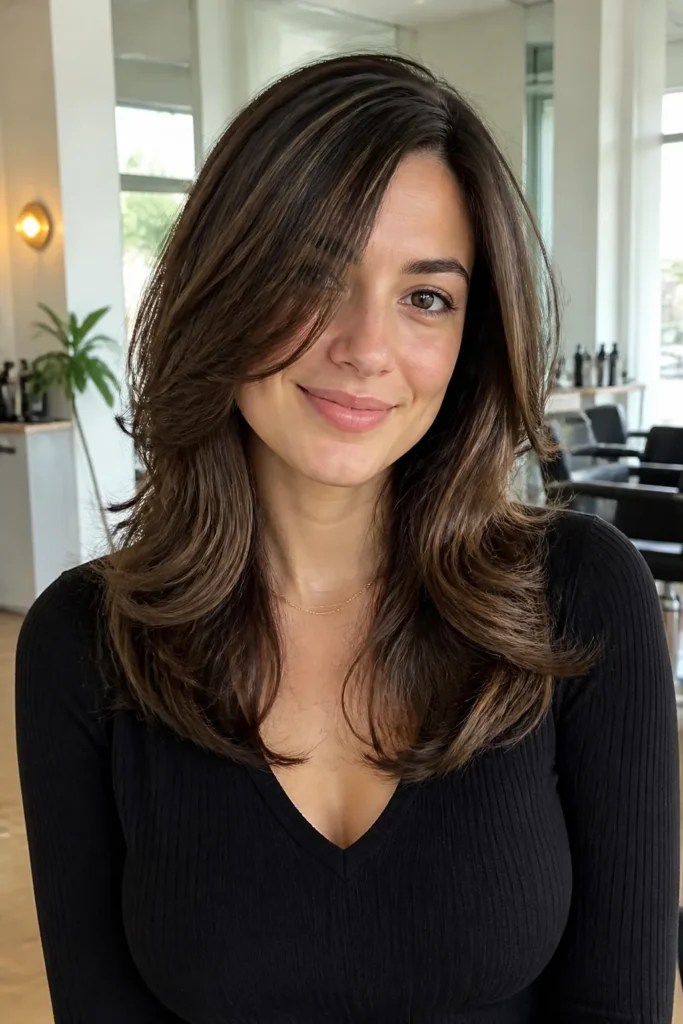
Wavy fine hair is the trickiest combination to layer, because the wave hides where the layers actually fall, and a cut that looks even when wet can look uneven when the waves dry. The solution is to cut the hair dry, or at least to check the layers as they dry naturally, so the stylist sees the real fall of the waves.
The layers should be long and few, not short and many. Three or four long layers through the lengths are enough to encourage the wave pattern and prevent the dreaded triangle shape, where wavy hair gets wide at the ends and flat at the top. Short layers on wavy fine hair create frizz at the crown and thin ends, which is the worst of both worlds.
This cut is the best choice if your fine hair has a natural wave that you want to encourage rather than fight. Wear it with a light curl cream scrunched through damp hair, and let it air dry or diffuse gently. Diffusing technique makes a real difference for wavy fine hair: use a low heat and low speed setting, cup sections of hair into the diffuser bowl, and hold still rather than moving the diffuser around, which creates frizz. Do not touch the hair while it dries, since touching breaks the curl pattern as it forms and turns soft waves into flyaways. Once the hair is fully dry, scrunch gently once more to break the cast of the curl cream, and the waves fall into their natural pattern. The layers will shape the waves into a soft, even pattern instead of letting them collapse into a flat top and wide ends.
9. Invisible Layers
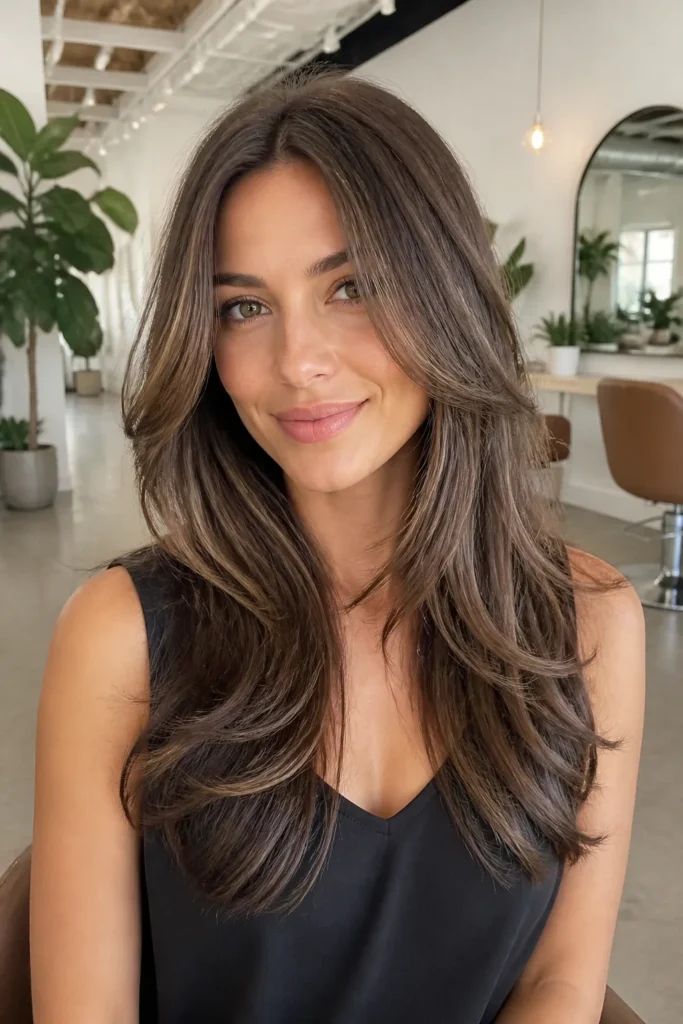
Invisible layers are the gentlest version of layering, and they are the best-kept secret for fine hair. The layers are cut entirely inside the hair, underneath the top section, so the surface looks like one solid length while the interior has movement and lift. From the outside, the hair looks blunt and full. From the inside, it has room to move.
The technique requires a stylist who understands fine hair, because invisible layers are easy to overdo. Ask for minimal internal layering, concentrated at the ends and underneath, with the top section left completely alone. The top section is what the world sees, and it should stay solid and smooth.
This cut is the best choice if you love the look of blunt, full hair but want it to move better and hold a style longer. It is also the best choice if you have been afraid of layers, because the result looks like no layers at all, just hair that behaves better. It grows out invisibly too, which means fewer emergency appointments.
Which One Should You Pick?
Pick by your goal first. If you want the safest change, start with long layers with face framing or invisible layers: both add movement without visible risk. If you want real fullness, the lob or the bob concentrate your hair into a smaller area and read as thicker immediately. If you want shape around the face, the curtain bangs version or the side part version put the fullness exactly where the eye lands.
Pick by your texture too. Straight fine hair suits the lob, the bob, and the feathered layers, which rely on clean lines. Wavy fine hair needs the wavy-specific version, cut with the waves in mind. And if your hair is very fine and very flat, avoid the choppy ends version until you have tried one of the gentler options, since texture at the ends helps only when the overall shape is already solid.
The one rule across all nine layered haircuts for fine hair: keep the perimeter strong and put the layers where they build lift, not where they remove weight. Short, scattered layers all over the head are what thin fine hair out. Long, connected layers in the right places are what make it look thicker. Bring photographs, name the version you want, and tell your stylist how you actually wear your hair, and the cut will work for you instead of against you.
FAQ
Will layers make my fine hair look thinner?
Only if they are cut wrong. Short, scattered layers all over the head remove the weight fine hair needs, and the result looks thinner. Long, connected layers that keep the perimeter strong create movement without removing bulk, and the hair looks thicker, not thinner. The difference is entirely in the placement, which is why the versions in this list specify where the layers sit.
How do I ask my stylist for layers without getting too many?
Be specific, and bring photographs. Name the version you want, say where the layers should start, and say that you want the perimeter kept blunt. Phrases like “long layers only” and “keep the bottom edge strong” give the stylist clear limits. If you are unsure, ask the stylist to cut fewer layers than you think you want: you can always add more at the next appointment, but you cannot put cut hair back.
How often should layered fine hair be trimmed?
Every eight to ten weeks for longer cuts, and every six to eight weeks for bobs and lobs. Layers grow out faster than blunt cuts, because the different lengths drift apart as they grow, and a trim resets the shape. Skipping trims is how a good layered cut slowly turns into an uneven one.
Can I style layered fine hair without heat?
Yes, especially the wavy version, which is designed to air dry into shape. For straight versions, a light mousse scrunched through damp hair and a gentle air dry gives soft movement, though it will not match the polish of a blow dry. Heat is a tool for these cuts, not a requirement, and the right cut should look decent even on a no-heat day.
What if my stylist cuts too many layers?
Do not panic, and do not try to fix it at home. Wear the hair with soft waves, which disguise uneven layering better than straight styling, and use a texturizing spray for fullness. At the next appointment, explain what went wrong and ask for a plan to grow the layers out evenly. These layered haircuts for fine hair are designed to grow out gracefully, and a good stylist can map the grow-out in stages.
The Bottom Line
Layers are not the enemy of fine hair, bad layering is. Keep the perimeter strong, put the layers where they build lift, and bring photographs and specific language to your appointment, and layers become the best tool fine hair has. That is the whole trick, and once you find the version that suits your hair, the cut does half the styling work for you every single day. These layered haircuts for fine hair work because they respect what fine hair actually needs: weight where it counts, movement where it shows, and a shape that grows out gracefully instead of falling apart.