What to Pack: A Practical Checklist for Trips and Travel Planning
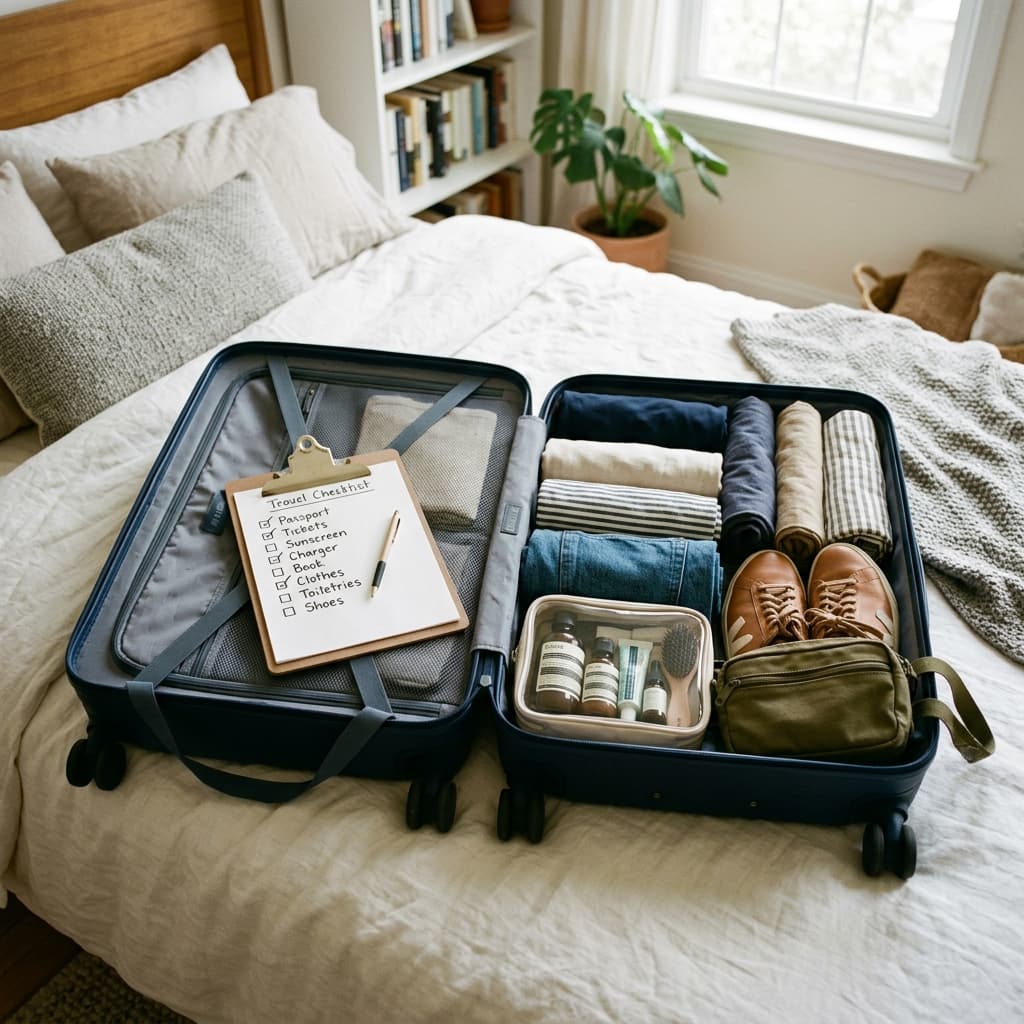
Packing Without the Panic
Packing for a trip can be just as stressful as the travel itself if you do not have a reliable system. Over the years, I've developed a foolproof packing checklist that adapts perfectly to both my destination and my current needs.
The Ultimate Packing Checklist
Here is the core formula for stress-free departures:
- The Essentials (Rule of Three): Three pairs of shoes max (one walking, one dressy, one casual), three neutral bottoms, and six coordinating tops.
- The Travel Prep Bag: Keep a pre-packed bag with travel-sized toiletries, chargers, and sleep masks ready to go at all times.
- The Clothing Roll Method: Roll your clothes instead of folding them. It saves space and prevents wrinkles.
Cognitive Energy Management and Habit Architecture
In our high-speed, modern world, productivity is often mischaracterized as working non-stop. However, true efficiency is not about managing your time—it is about managing your cognitive energy. The human brain is not designed for continuous, high-level focus. According to cognitive science, our mental energy peaks and valleys follow ultradian rhythms, which typically run in 90 to 120-minute cycles.
To maximize your output, align your schedule with these natural energy waves.
The Principles of Habit Stacking
Building a supportive routine is much easier when you use "habit stacking," a concept popularized by James Clear. Instead of trying to build a new habit from scratch, anchor it to an existing, automatic habit. For example, if you want to start a daily stretching routine, stack it directly after your morning coffee: "After I pour my morning coffee, I will sit on my mat and stretch for 5 minutes." This utilizes existing neural pathways, reducing the willpower required to start.
| Concept | Definition | Practical Application | Expected Benefit |
|---|---|---|---|
| Ultradian Rhythms | Natural 90-120 min energy cycles | Work for 90 mins, take a 10 min active break | Prevents burnout, maintains focus |
| Habit Stacking | Anchoring new habits to old ones | "After I brush my teeth, I will write 3 gratitude lines" | Lowers willpower barrier |
| Time Blocking | Dedicating blocks to specific tasks | Block 9-11 AM for deep work (No phone/Slack) | Eliminates task-switching fatigue |
| Digital Boundaries | Restricting device notifications | Put phone on Do Not Disturb during focus hours | Restores attention span |
The Physiology of Rest and Active Recovery
Rest is not a luxury; it is a physiological necessity. When we sleep or rest, the brain activates the glymphatic system—a waste clearance mechanism that flushes out metabolic toxins that accumulate during waking hours. Chronic lack of rest keeps the body in a prolonged state of fight-or-flight, elevating cortisol levels and causing long-term health issues.
It is helpful to distinguish between passive rest (like sleeping or napping) and active recovery. Active recovery includes low-stakes, restorative activities that engage different parts of your brain: walking in nature, cooking a slow meal without screens, or working on a tactile hobby. These activities allow your prefrontal cortex (the decision-making center) to recharge.
Creating a Supportive Environment and Boundaries
Your physical environment and personal boundaries are the foundations of a sustainable lifestyle.
- Optimize Your Workspace: Keep your desk clear of visual clutter. Visual clutter competes for your brain's attention, increasing cognitive load and stress levels. Ensure your chair and screen are set to proper ergonomic heights to prevent physical fatigue.
- Establish Digital Sunsets: Disconnect from all work communication and social media at least one hour before bed. The blue light emitted by screens suppresses melatonin production, delaying sleep onset and degrading sleep quality.
- Practice the Art of Saying No: Every time you agree to a low-priority task, you are saying no to your core priorities, your rest, and your family. Guard your calendar aggressively. Saying no is a necessary boundary to protect your energy and focus for the things that truly matter.
Frequently Asked Questions (FAQ)
What is the "5-4-3-2-1" packing rule?
For a week-long trip, pack: 5 pairs of socks and underwear, 4 tops, 3 bottoms, 2 pairs of shoes, and 1 hat/swimwear/jacket.
How do I keep my suitcase organized?
Use lightweight packing cubes to separate tops, bottoms, and undergarments, and roll your clothes instead of folding them.
What toilet items are essential to pack?
Keep a pre-packed travel pouch with travel-sized shampoo, face cleanser, moisturizer, toothbrush, toothpaste, and daily SPF.
How do I pack light?
Choose a cohesive color palette so all tops and bottoms can be mixed and matched to create multiple outfits from fewer items. \n\n
Advanced Curation & Styling Recommendations
When implementing these tips, it is helpful to look at the historical context of how these styles and routines evolved. In modern fashion and beauty culture, the line between daily comfort and curated presentation has become increasingly blurred. We no longer separate our "active" life from our "styled" life. This shift requires us to choose high-performance products and techniques that can withstand the demands of a busy lifestyle while remaining visually polished.
The Role of Mindful Selection
When choosing products—whether it's nail polishes, hair tools, skincare ingredients, or wardrobe fabrics—always prioritize quality over quantity. A minimalist collection of ten high-quality items is significantly more useful and looks more polished than a massive collection of low-quality, cheap items.
- For Beauty & Skincare: Focus on clean, dermatologically-tested formulations that list active ingredients clearly. Avoid products with heavy synthetic fragrances that can trigger sensitivity over time.
- For Fashion & Style: Invest in garments with clean stitching and finished seams. Check the weight of the fabric; heavier cottons and wools hold their shape better and look more structured.
- For Lifestyle & Planning: Focus on simple, intuitive tools that don't require hours of setup. A tool is only useful if it reduces your stress, not if it adds to your mental load.
Final Editorial Takeaway
Our editorial team stands by the philosophy that personal style should be accessible, practical, and highly individualized. There is no single "right" way to style a curtain bang, apply a nude lipstick, organize a closet, or plan your week. The tips and frameworks in this guide are designed to be a launchpad for your own exploration. Experiment with different colors, try styling variations, adjust the guidelines to fit your daily constraints, and document what makes you feel the most confident and energized.
By treating your beauty and organization routines as a form of creative self-expression rather than a set of strict rules, you will enjoy the process significantly more. Allow yourself to be an amateur, try new things, and let your style evolve naturally over time.
Editorial Inspiration Checklist & Final Takeaways
To help you implement this guide in your daily life, here is a quick summary checklist created by our editorial staff:
- Audit Your Space & Tools: Start by checking the quality of your products. Ensure your styling tools, cosmetics, or lifestyle organizers are clean and within their expiration dates.
- Start with Small Changes: Do not attempt to overhaul your entire routine in a single day. Implement one new trend or habit, test it for a week, and refine it based on your results.
- Focus on Consistency: The secret to beauty, style, and productivity is consistency. It is better to perform a small 5-minute daily routine than a massive weekly one.
- Document Your Progress: Take photos of your nail designs, note how your hair responds to different styling temperatures, or log your daily energy levels in a physical journal. Tracking your own data helps you find what works best for you.
By prioritizing high-quality ingredients, clean techniques, and realistic goals, you ensure that your styling choices support your lifestyle rather than draining your energy. Remember, beauty and organization should be enjoyable and empowering, not a source of stress. Take your time, enjoy the process, and let your personal style naturally evolve.