Gel Manicure at Home: Step-by-Step DIY Guide
Skip the salon prices and master the art of the perfect, long-lasting DIY gel manicure at home with our detailed guide.
📌 At a Glance (Key Takeaways)
- Proper nail plate dehydration and cuticle prep account for 90% of gel manicure longevity.
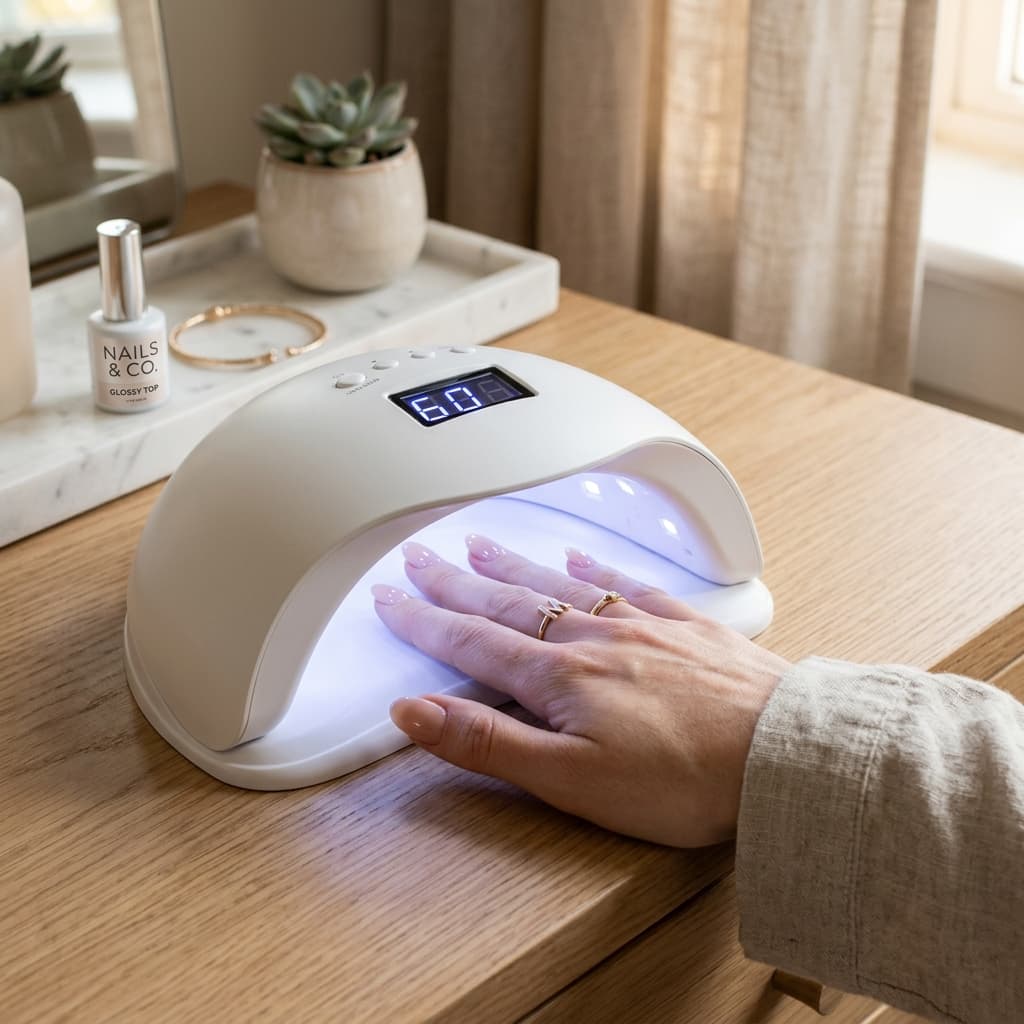
- Requires a 36W or 48W LED/UV lamp with proper 60-second curing cycles for full polymerization.
- Capping the free edge on every coat prevents premature chipping and tip peeling.
- Safe removal via pure acetone soak-off prevents keratin damage and thinning nail beds.
Direct Answer: A gel manicure at home is a long-lasting nail treatment utilizing light-cured oligomer polish set under an LED or UV lamp. Achieving a salon-quality, 3-week wear time requires thorough dry cuticle removal, alcohol dehydration of the natural nail plate, thin coat application with free-edge capping, and full 60-second curing between layers.
Getting a professional gel manicure is a luxury, but the recurring cost and hours spent in a salon chair add up quickly. Fortunately, with the right equipment and an understanding of nail prep science, you can achieve a flawless, high-gloss gel manicure at home that rivals any top salon.
The true secret to longevity is not the brand of polish you buy, but your mechanical preparation of the nail bed, the thinness of your layers, and precision UV/LED curing. When executed correctly, an at-home gel manicure will remain completely chip-free, glossy, and resilient for up to three full weeks.
The Chemistry of Gel Polish: Why Proper Curing Matters
Traditional nail lacquer dries through solvent evaporation, leaving behind a fragile nitrocellulose film that chips and cracks within days under everyday mechanical wear. In sharp contrast, gel polish relies on liquid acrylate oligomers, monomers, and photo-initiators.
When exposed to specific wavelengths of ultraviolet (365nm) or light-emitting diode (405nm) light, the photo-initiators trigger an immediate cross-linking polymerization reaction. The liquid monomers bind together into a dense, solid macromolecular plastic lattice. When cured completely, this polymer shield is flexible, impervious to household detergents and hot water, and bonded tenaciously to the keratin surface of your natural nail plate.
The Complete Tool & Equipment Checklist for At-Home Gel Success
Before beginning your manicure, organize all required supplies on a clean, lint-free towel. Touching other objects mid-manicure transfers sebum back to your dehydrated nail plates, triggering premature lifting:
- Dual-Wavelength LED/UV Lamp: Choose a lamp rated at minimum 36W to 48W equipped with 365nm + 405nm dual diodes. Underpowered mini lamps fail to fully cure deeper color layers, leading to wrinkling and allergic sensitization.
- Nail Dehydrator & Acid-Free Primer: Dehydrators remove residual moisture from keratin plates, while primers deposit double-sided covalent bonding agents that anchor base coats to the nail surface.
- Professional Gel Base Coat & No-Wipe Top Coat: Formulated specifically for light-curing systems. Never attempt to use standard air-dry base coats beneath gel colors.
- Pigmented Gel Colors: High-viscosity, high-pigment soak-off gel polishes.
- 90%+ Isopropyl Alcohol & Lint-Free Wipes: Regular cotton balls deposit loose fibers that ruin smooth gel coats. Lint-free wipes saturated with 90%+ alcohol are mandatory for surface purification.
- Double-Ended Stainless Steel Cuticle Pusher & Nippers: For safely pushing back proximal nail folds and removing dead pterygium tissue.
- Nail Files & Buffers: A 180-grit wooden or glass file for perimeter shaping, and a fine 220/240-grit buffer block for gently removing natural surface oils.
- Cold-Pressed Jojoba Cuticle Oil: Crucial for re-hydrating the surrounding skin and maintaining nail plate flexibility post-cure.
- 100% Pure Acetone & Aluminum Removal Foil Wraps: For damage-free removal without prying or scraping.
Step-by-Step Professional Gel Protocol (No Lifting Guarantee)
Follow this six-step salon methodology to eliminate peeling, bubbling, and lifting at the cuticle line:
Step 1: Dry Cuticle Prep & Perimeter Shaping
Never soak your hands in water or apply cuticle remover cream prior to a gel manicure. Water causes natural keratin plates to swell; as that moisture gradually evaporates beneath the cured gel over the next 48 hours, the nail plate shrinks, guaranteeing lateral lifting. Use a stainless steel pusher to gently nudge back the cuticle fold, then lightly scrape away any translucent dead skin (pterygium) stuck flat to the nail bed. Shape your perimeter using a 180-grit file, filing in a single direction to prevent edge delamination.
Step 2: Gentle Surface De-Shining
Take a fine 240-grit buffer and lightly graze the surface of each nail plate in the direction of natural nail growth. The goal is not to thin or weaken the nail, but simply to remove the smooth, reflective natural oil sheen. This creates microscopic surface texture that allows the primer to grip firmly.
Step 3: Dehydrate and Prime
Soak a lint-free wipe in 90%+ isopropyl alcohol and vigorously scrub each nail plate, paying special attention to lateral sidewalls and the cuticle perimeter. Once dry, apply a single thin swipe of acid-free primer. Allow the primer to air-dry for 30 seconds until the surface appears completely matte or slightly tacky.
Step 4: Ultra-Thin Base Coat & Free Edge Cap
Apply a paper-thin coat of gel base coat. Keep the brush roughly 1 millimeter away from the proximal cuticle fold to prevent flooding the skin. The Non-Negotiable Step: Run the edge of your brush horizontally along the free edge of your nail tip. "Capping" the free edge forms a physical seal that prevents water from seeping between the natural nail and the polish. Cure for 30 seconds under LED (or 60 seconds under UV).
Step 5: Two Micro-Thin Color Coats
Apply your first coat of colored gel polish using the "three-stroke method": one stroke down the center from base to tip, followed by one stroke along each side. The initial coat should look semi-translucent; never apply a thick layer to achieve immediate opacity, as UV light cannot penetrate dense pigment, causing the interior polish to stay wet and wrinkle. Cap the free edge on every coat. If any gel touches skin, wipe it off immediately with an alcohol-soaked brush before curing. Cure under LED for 60 seconds. Apply a second thin coat, cap the edge, and cure for another 60 seconds.
Step 6: High-Gloss Top Coat & Cuticle Nourishment
Apply a smooth layer of no-wipe gel top coat over the entire nail surface, ensuring complete coverage over the color and capping the free edge once more. Cure under LED for a full 60 seconds. If using a traditional wipe-off top coat, saturate a fresh lint-free wipe with 90% isopropyl alcohol and firmly wipe away the tacky dispersion layer. Finish by massaging 2 drops of cold-pressed jojoba cuticle oil into each finger to replenish lipid reserves.
Lamp Power & Curing Times Matrix
| Lamp Type | Wattage | Base Coat Cure | Color Coat Cure | Top Coat Cure |
|---|---|---|---|---|
| Compact Home LED Lamp | 24W | 45 Seconds | 60 Seconds | 60 Seconds |
| Professional High-Power LED/UV | 48W – 54W | 30 Seconds | 60 Seconds | 60 Seconds |
| Traditional Fluorescent UV Lamp | 36W | 60 Seconds | 120 Seconds | 120 Seconds |
Safe Removal Protocol: Preventing Nail Damage
The single greatest cause of damaged, peeling natural nails is improper gel removal. Never peel, pick, or pry cured gel off your nails, as this rips off the outermost dorsal keratin layers:
- Break the Protective Top Seal: Using a 180-grit coarse file, buff off the shiny top coat completely until the nail appears chalky and dull. This allows acetone to penetrate through the impenetrable top polymer layer.
- Acetone Cotton Saturation: Soak half of a cotton ball in 100% pure acetone (do not use regular diluted nail polish remover). Place it directly on top of the nail plate.
- Tightly Wrap with Aluminum Foil: Wrap each fingertip snugly in aluminum foil squares, crimping the tip to trap body heat. Body heat accelerates acetone evaporation into the gel matrix.
- Wait 12 to 15 Minutes: Allow the acetone to break the cross-linked bonds undisturbed. Resist the urge to peek before the 12-minute mark.
- Slide Off Gently: Remove the foil wraps with a twisting motion. The gel will appear expanded and crumbly. Gently push it off using an orange wood cuticle stick. If any spots adhere stubbornly, re-wrap for 5 additional minutes rather than scraping.
Salon Technician Care & Longevity Troubleshooting Guide
To ensure your manicure remains flawless, glossy, and chip-free for weeks, follow these professional technician guidelines:
- The Golden 2-Hour Moisture Rule: Avoid submerging hands in hot water, taking long baths, or washing dishes for at least 2 hours after your manicure. Even cured polish benefits from stabilization before prolonged thermal exposure.
- Cuticle Oil Micro-Absorption Science: Apply cold-pressed jojoba and vitamin E oil twice daily directly along the eponychium (cuticle fold) and under the free edge. Jojoba penetrates the keratin matrix, maintaining flexibility so nails bend under pressure rather than snapping.
- Protecting from Chemical Degradation: Common household cleaning sprays, dish soaps, and acetone-containing sanitizers degrade top coat resins. Always wear cotton-lined waterproof gloves when performing wet domestic chores.
- Preventing Mechanical Stress: Never use your fingernails as scraping tools to open soda cans, peel labels, or press buttons. Train yourself to use the pads of your fingers or utility tools to protect the structural apex of your nails.
- Regular Hydration Over Sealing: Keeping cuticles nourished prevents hangnails and lateral wall splits, maintaining healthy nail beds between salon visits.
Learn how to maintain nail strength between manicures in How to Strengthen Natural Nails and explore inspiration in Modern French Tip Nails.
Frequently Asked Questions
Why does my gel polish peel off in one whole sheet after two days?
This is almost always caused by improper prep: either natural oils were left on the nail plate, hands were soaked in water before application, or gel polish was flooded onto the cuticle skin, breaking the airtight seal.
Does curing gel polish under UV/LED lamps damage the skin?
LED nail lamps emit very low levels of UVA light for brief 60-second intervals. However, wearing fingerless UV protection gloves or applying broad-spectrum mineral sunscreen to hands 20 minutes prior completely eliminates skin risks.
How long can you safely leave a gel manicure on?
A gel manicure should be safely soaked off after 2 to 3 weeks. Leaving gel on for 4+ weeks creates leverage stress on the nail bed as your natural nail grows out, increasing the risk of painful breaks.
Can I use regular nail polish with a gel top coat?
Only if the regular polish is 100% dry (which takes 12 to 24 hours of air drying). If moisture or solvents remain trapped under the cured gel top coat, the polish will wrinkle and peel immediately.