
📌 At a Glance (Key Takeaways)
- Modern French manicures replace stark white bands with micro-tips, metallic chrome, and negative space.
- Almond, oval, and squoval shapes visually elongate fingers and create elegant tip proportions.
- Using a silicone stamper or fine liner striping brush guarantees razor-sharp smile lines at home.
- Milky nude or translucent pink jelly base colors provide a soft, contemporary foundation.
People still picture the French manicure as a bit dated: chalky white tips, thick and blocky, on chunky square nails circa 2003. That version has aged, sure. But the French tip itself never went anywhere. It just got quieter and more precise. The line got thinner, the colors opened up, and negative space crept in. Done well, a modern French reads as clean and current, not nostalgic.
A quick bit of history explains why it endures: Jeff Pink created the look in 1975 for Hollywood actresses who needed nails that worked with any costume change. That adaptability is still the whole appeal. Swap the color or the line and it suits almost any outfit or occasion. Here are the variations worth knowing, roughly in order of how easy they are to pull off at home.
The five that actually get requested
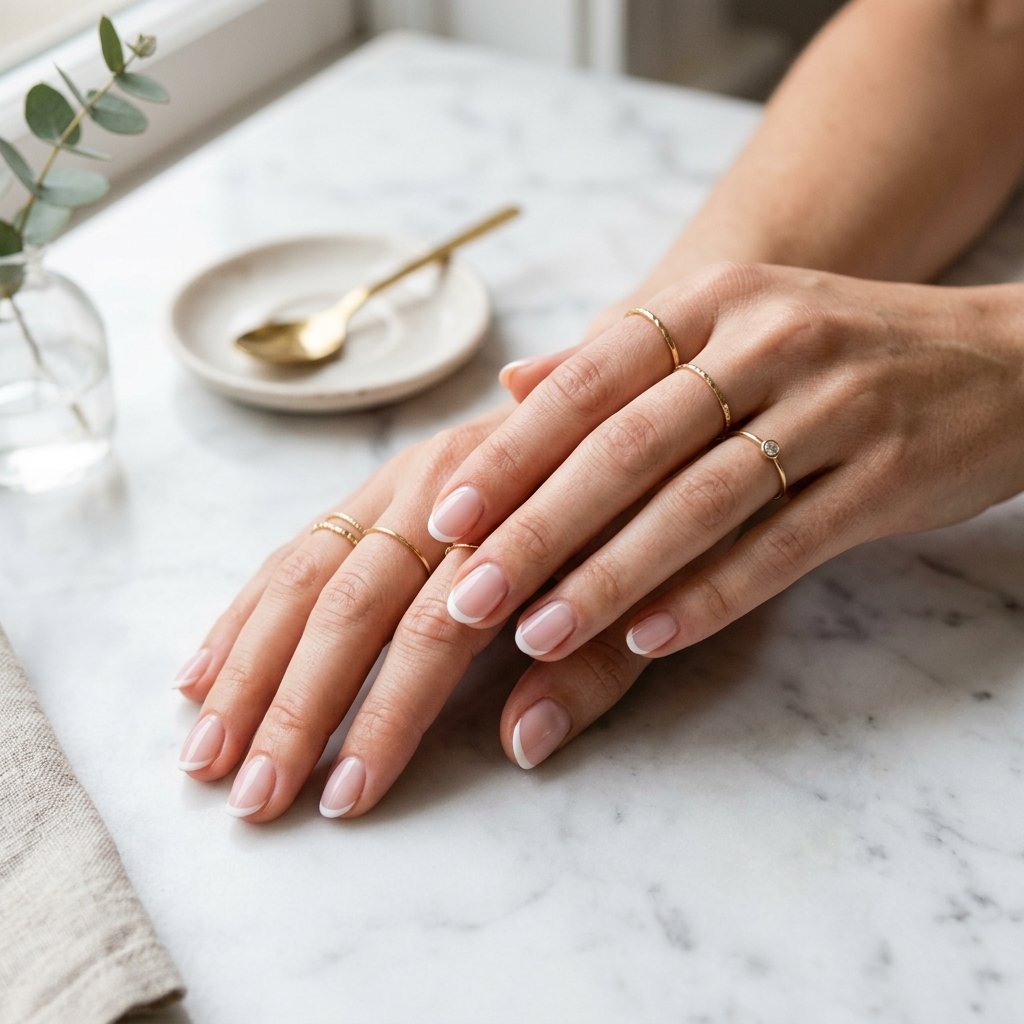
The micro French. The minimalist favorite. Instead of a wide band, you trace a razor-thin line, under a millimeter, right along the tip, usually over a milky or sheer base. It’s flattering on short natural nails and about as understated as nail art gets. This is the easiest to attempt yourself.
Colored and pastel tips. The quickest way to make the look feel modern is to drop the white entirely. A soft pastel for spring, a jewel tone like hunter green or navy for colder months, or a different pastel on each finger for something playful. A pale blue tip over a glossy pink base is a clean, pretty combination.
Chrome tips. Gold, silver, or iridescent chrome on the tips catches the light and looks expensive, especially over a matte nude base where the contrast between flat and reflective does the work. It’s the hardest of the group because it involves chrome powder over a flash-cured top coat, but the payoff is worth it for events.
The double French. Two thin parallel lines at the tip with a sliver of bare nail between them. Graphic and geometric, it suits anyone who likes structural design. High-contrast pairings like black and white or navy and gold show it off best.
The V-cut (chevron). Instead of a rounded smile line, two diagonal lines meet at a point in the center of the tip. It visually lengthens the finger, which is why it’s popular on almond and coffin shapes.
If you want to see where chrome and structural tips fit into the bigger picture, our “Acrylic Nail Trends 2026” guide covers the shapes that carry these designs best.
Here’s a quick way to match a variation to your nails:
| Variation | Length | Shape | Difficulty |
|---|---|---|---|
| Micro French | Short | Square / round | Easy |
| Colored | Medium | Oval / almond | Medium |
| Chrome | Long | Almond | Hard |
| Double | Medium | Almond | Hard |
| V-cut | Long | Coffin / stiletto | Medium |
Getting a clean line at home
The smile line is where home attempts fall apart. Drawing a smooth, even curve freehand is genuinely hard, so most people who do this well cheat with one of three methods.
The silicone stamper trick is the most reliable. Paint a thick strip of your tip color onto a soft silicone jelly stamper, then press your fingertip into it at a 45-degree angle. The silicone wraps around your nail and transfers a perfectly even curve in one motion. Cure, then clean up any polish that got onto your skin with a flat brush dipped in acetone or alcohol.
If you’d rather not buy a stamper, curved paper stencils work too: stick them onto your dried base coat, paint the tips, and peel them off while the polish is still wet. And if you do go freehand, don’t chase perfection with the brush. Draw the line roughly, then sharpen it afterward with an angled brush dipped in remover, sweeping away the excess until the curve is crisp. Cleanup is where the clean line really comes from.
One note on proportion, since it’s the thing that separates a modern French from an old one: keep the tip thin and let it follow the natural curve of your free edge. A tip that’s too thick or drawn straight across is exactly what makes the look feel stuck in an earlier decade.
For a seasonal spin, our “Fall Nail Colors” guide has deeper shades that work beautifully as colored tips once the weather turns.
Frequently Asked Questions
Can you do French tip nails on short natural nails?
Yes! The micro French (baby French) was specifically created for short nails. Keeping the line under 1mm prevents the tip from making short nails appear stubby.
What is the best base color for a modern French manicure?
Translucent ‘jelly’ nudes, sheer milky whites, and soft petal pinks that match your natural nail bed undertone provide the most modern, seamless foundation.
How do I make my French tips look symmetrical on both hands?
Mark the center point of each nail tip with a tiny dot first using a toothpick or fine brush. Then paint from the outer corner down to the center point on each side.
Why do French tips chip faster than a full color manicure?
Because tips endure the highest mechanical friction from typing and opening packages. Always cap the free edge with your top coat and apply cuticle oil daily to prevent brittleness.
Additional Details
- Description: From micro-tips to metallic accents, explore 5 modern ways to reinvent the classic French manicure for a contemporary look.
- Published: 2026-06-10T00:00:00.000Z
- Updated: 2026-09-07T00:00:00.000Z
Images
- (none listed)